


- 画像をクリックすると拡大します。
- 自己紹介は招待制のSlackへリンクします。
| グループ1 | グループ2 | グループ3 | グループ4 |
| Ayaka | こと | りんりん | おみお |
| アマギリ | かの | みん | りえ |
| 豆 | ポーイー | クルマ | 月曜日 |
| ザフィラ | りな | 桃 | 葉子 |
| オミ | ジョーユ | 月 | トニ |
| みっちゃん(L) | ネラ | さらさん(L) | しずく |
| ゆうかさん(L) | ざいさん(L) | もくもくさん(L) | りくさん(L) |
| さっちゃん(L) | すみちゃん(L) | えりさん(L兼任) |
ワンページャーの課題
- 2つのテーマの「答え」を1枚の紙に描く。
- イラストや写真などでわかるようにする。
- 文字は少なく、簡潔な日本語で書く。
ワンページャーのテーマ
- ①「水」を使った料理を1つ紹介する(いつも食べている料理 または 好きな料理)。
- ②わたしが気になった「水」のニュース または わたしが「水」に関して研究や活動していること。
自己紹介ビデオの課題
- 長さは15秒~30秒にする。
- スマホ(スマートフォン)のビデオ撮影で良い。
自己紹介ビデオのテーマ
- ①わたしが飲んでいる「水」 または/と わたしの周りにある「水」。
- ②わたしが1日に使う「水」の量。
- ビデオ編集ができるひとは、ナレーション、テロップや字幕で入れる。あるいは口頭発表でも良い。
- Ayaka
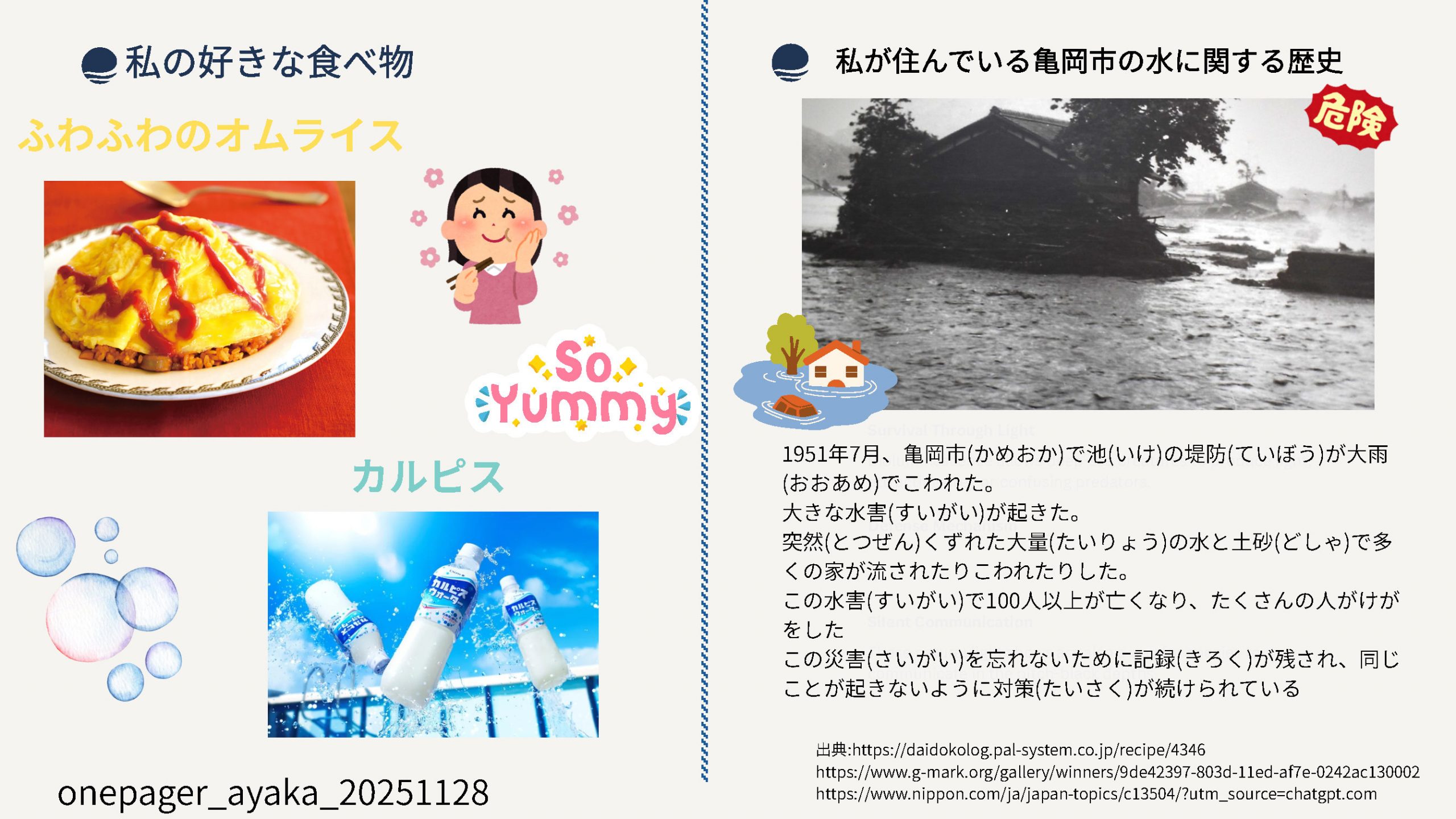
池(いけ)/ため池、災害(さいがい)、堤防決壊(ていぼう けっかい)、大雨(おおあめ)、家の流出(りゅうしゅつ)や損壊(そんかい)、死者災害(ししゃ さいがい)、記録(きろく)と対策(たいさく)、日本
- <ワンページャーの出典>
- 好きな料理
- https://daidokolog.pal-system.co.jp/recipe/4346
- 好きな飲みもの
- https://www.g-mark.org/gallery/winners/9de42397-803d-11ed-af7e-0242ac130002
- 亀岡市の水に関する歴史 「平和池災害モニュメント」: ため池決壊死者114人 惨事を後世に引き継ぐことこそ使命
- https://www.nippon.com/ja/japan-topics/c13504/?utm_source=chatgpt.com
- <ワンページャーの出典>
- <自己紹介ビデオの出典>
- <自己紹介ビデオのテロップ>
- わたしはきょうとふのかめおかしに住んでいます。山にかこまれていてしぜんがおおいです。
- 私がすんでいるかめおかしにはほずがわがながれています
- かめおかしはちかすいがほうふで、私はふだんちかすいをじょうかした水をのんでいます。
- Thank you for watching
- <自己紹介ビデオのテロップ>
- アマギリ(amagiri)
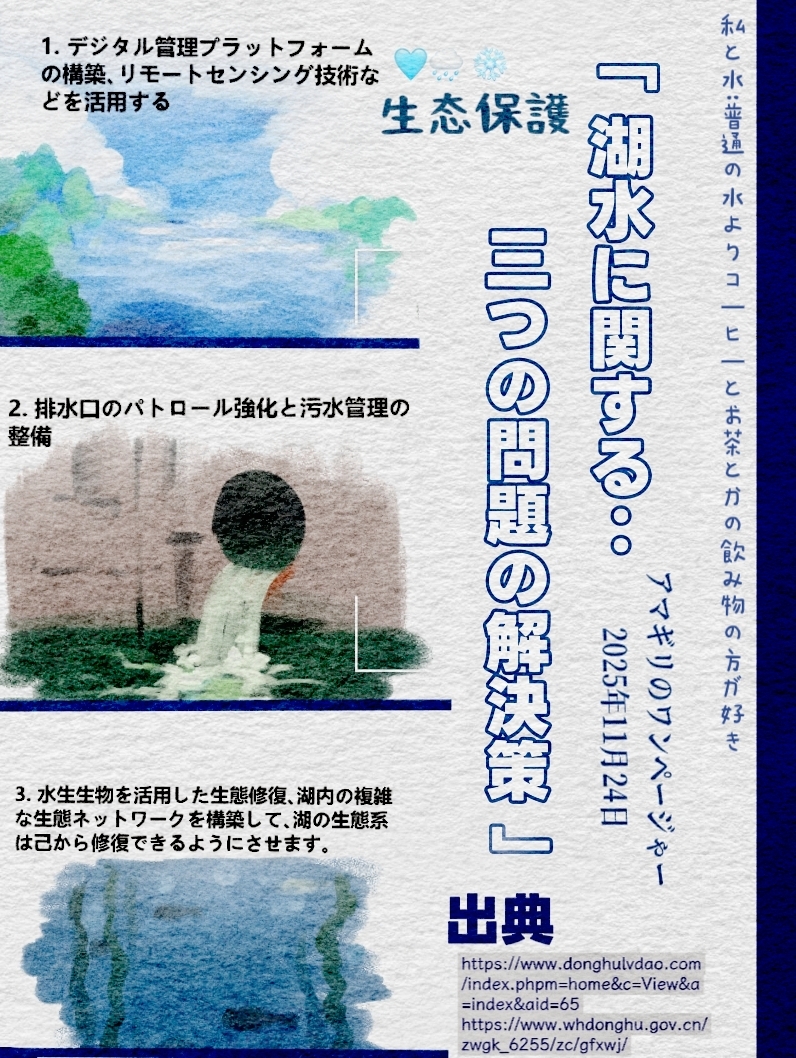
湖水(こすい)、汚水管理(おすい かんり)、デジタル技術(ぎじゅつ)、パトロール、水生生物(すいせい せいぶつ)、生態系(せいたいけい)、中国
- 自己紹介ビデオ(YouTube)へリンク
- 豆
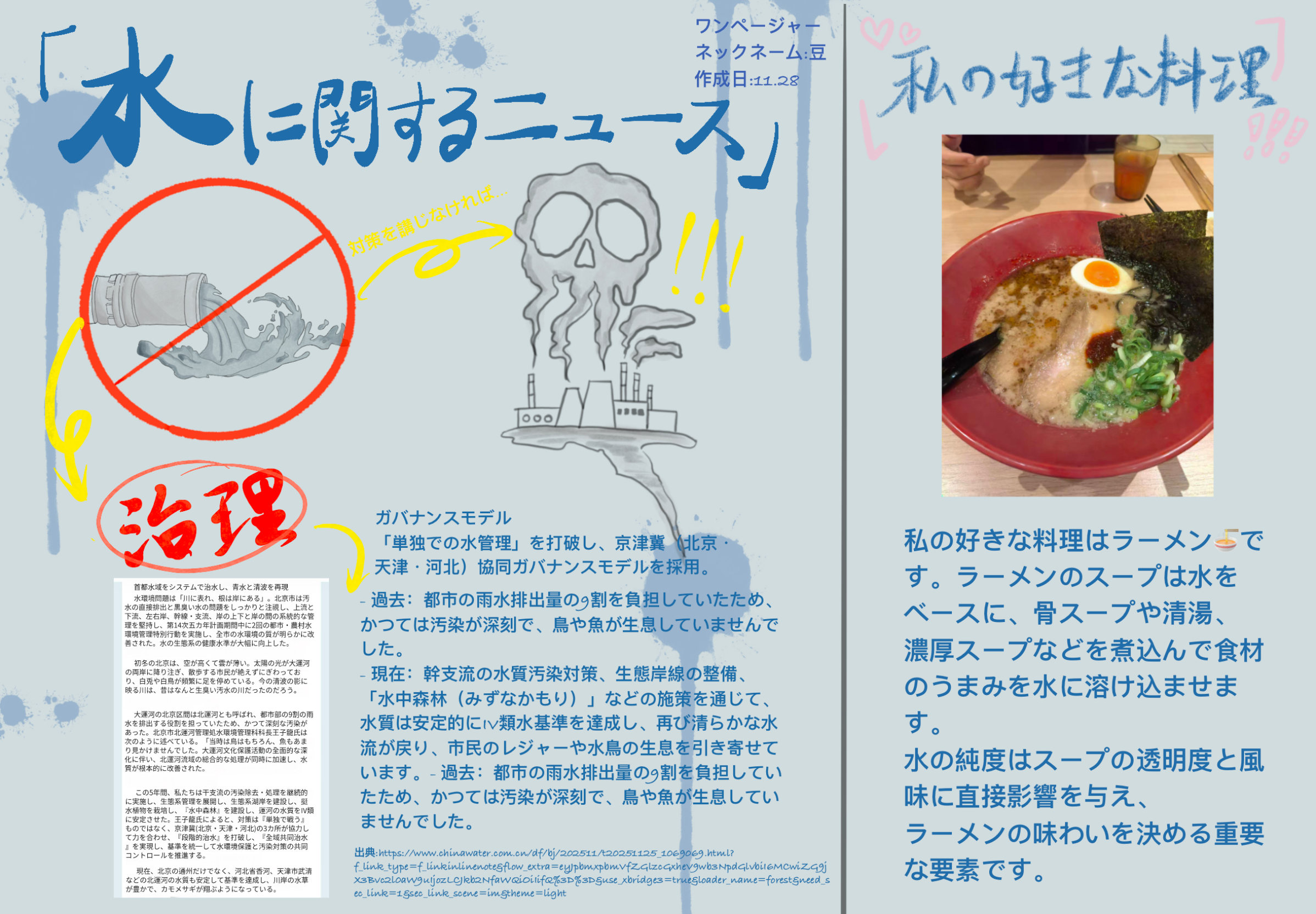
河川(かせん)、北京など、広域的な(こういきてきな)協同(きょうどう)ガバナンスモデル、水質汚染(すいしつ おせん)、生態系湖岸(せいたいけい こがん)、水中森林(みずなかもり)、再生水(さいせいすい)の利用、中国
- <ワンページャーの出典>
- <自己紹介ビデオのテロップ>
- 朝に歯を磨き顔を洗いて、蛇口から出る水を使いました。一日が始まりました。
- 学校の休み時間に水を一杯汲みました。
- 体育の授業が終わって手を洗いました。
- 家に帰って、また手を洗いました。
- また一杯水を注ぎました。今日はジャスミン茶を飲みました。
- 今日は花に水をやり忘れませんでした
- <自己紹介ビデオのテロップ>
- ザフィラ
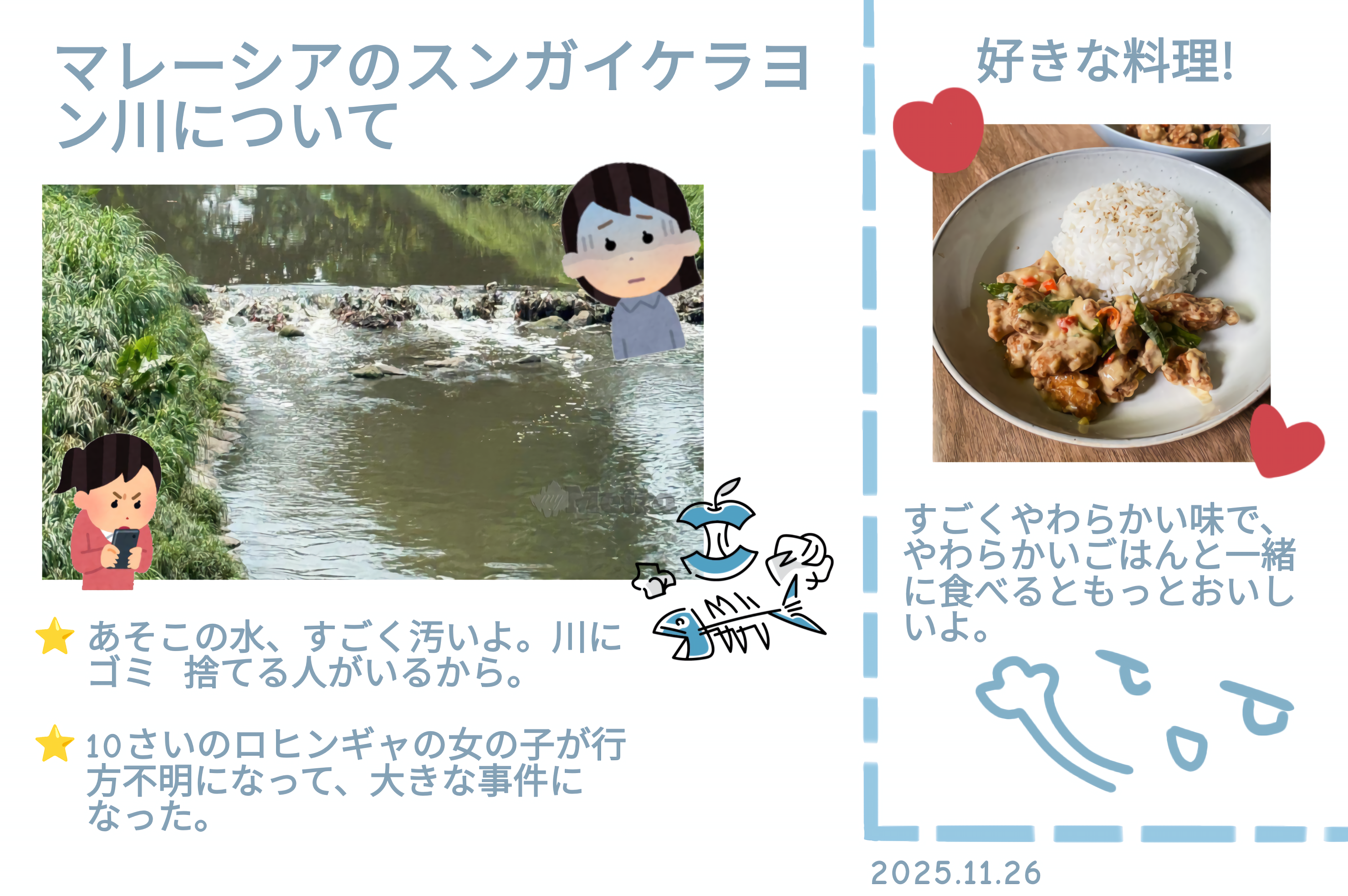
河川(かせん)、スンガイケラヨン川、水質汚染(すいしつ おせん)、ゴミ投棄(とうき)、行方不明事件(ゆくえふめい じけん)、マレーシア
- オミ
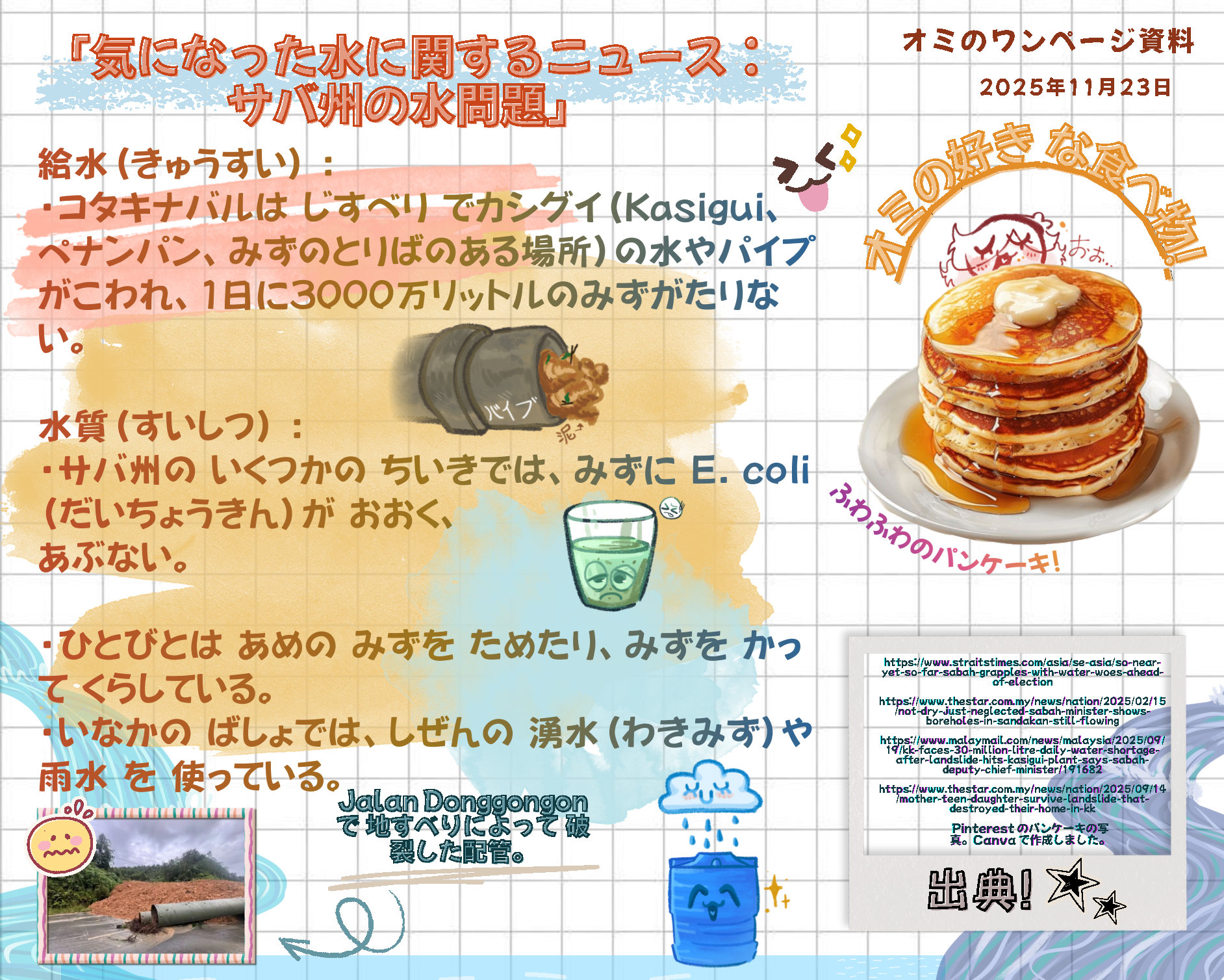
水道インフラ、豪雨(ごうう)、土砂崩れ(どしゃ くずれ)、浄水場(じょうすいじょう)と送水管(そうすいかん)の破損(はそん)、慢性的な(まんせいてきな)水道インフラ不足と給水不足(きゅうすい ぶそく)、ボトル入り水の高い大腸菌濃度(だいちょうきん)、雨水(あまみず)、わき水、マレーシア
- <ワンページャーの出展>
- The Straits Times 20251114 So near yet so far: Sabah grapples with water woes ahead of election
- https://www.straitstimes.com/asia/se-asia/so-near-yet-so-far-sabah-grapples-with-water-woes-ahead-of-election
- The Star 20250215 Not dry, just neglected: Sabah Minister shows boreholes in Sandakan still flowing
- https://www.thestar.com.my/news/nation/2025/02/15/not-dry-just-neglected-sabah-minister-shows-boreholes-in-sandakan-still-flowing
- Malaymail 20250919 KK faces 30 million-litre daily water shortage after landslide hits Kasigui Plant, says Sabah deputy chief minister
- https://www.malaymail.com/news/malaysia/2025/09/19/kk-faces-30-million-litre-daily-water-shortage-after-landslide-hits-kasigui-plant-says-sabah-deputy-chief-minister/191682
- The Star 20250914 Mother, teen daughter survive landslide that destroyed their home in KK
- https://www.thestar.com.my/news/nation/2025/09/14/mother-teen-daughter-survive-landslide-that-destroyed-their-home-in-kk
- <ワンページャーの出展>
- <自己紹介ビデオのテロップ>
- 私はマレーシアのサバ州に住んでいます
- ミロみたいなドリンクを作るときは、 ウォーターサーバーを使うことが多いですあと、たまには,コーヒーも
- 絵を描いているときは 、水分補給のために常に水を近くに置いておきます
- <自己紹介ビデオのテロップ>
- オミの日常の水の使い方:
- 1) 洗濯- 60L
- 2) 入浴 (シャワー-80L、「トイレー 15L、歯磨き用一 2L)
- 3) 食器洗い- 10L
- 4) 飲み物- 3L
- 合計 = 170L
- こと

湖沼(こしょう)、琵琶湖(びわこ)、琵琶湖を守る活動(まもる かつどう)、藻(も、水生植物)、藻の活用(かつよう)、日本
- <自己紹介ビデオのテロップ>
- こんにちは。わたしは日本の 滋賀県(しがけん)にすんでいます。
- 滋賀県には日本で 1 番大きい湖(みずうみ)があるよ
- 琵琶湖(びわこ)です!
- 滋賀県の面積(めんせき)の 6 分の 1 の 大きさ!
- やすみの 日は琵琶湖であそぶこともあるよ!
- 私がつかっているのはちかくの 川の 水です! 琵琶湖の 水ではないよ!
- そのままでものむことができますが、、
- 私はいつも 麦茶(むぎちゃ)にしてのんでいます
- 紅茶(こうちゃ)も 大好き!
- 私が 1 日につかっている 水の 量(りょう)
- おふろ…180L
- 洗面(せんめん)・てあらい…10L
- トイレ…30L
- はみがき…1L
- りょうり・のみ水…4L
- せんたく…30L
- 合計…255L
- <自己紹介ビデオのテロップ>
- かの
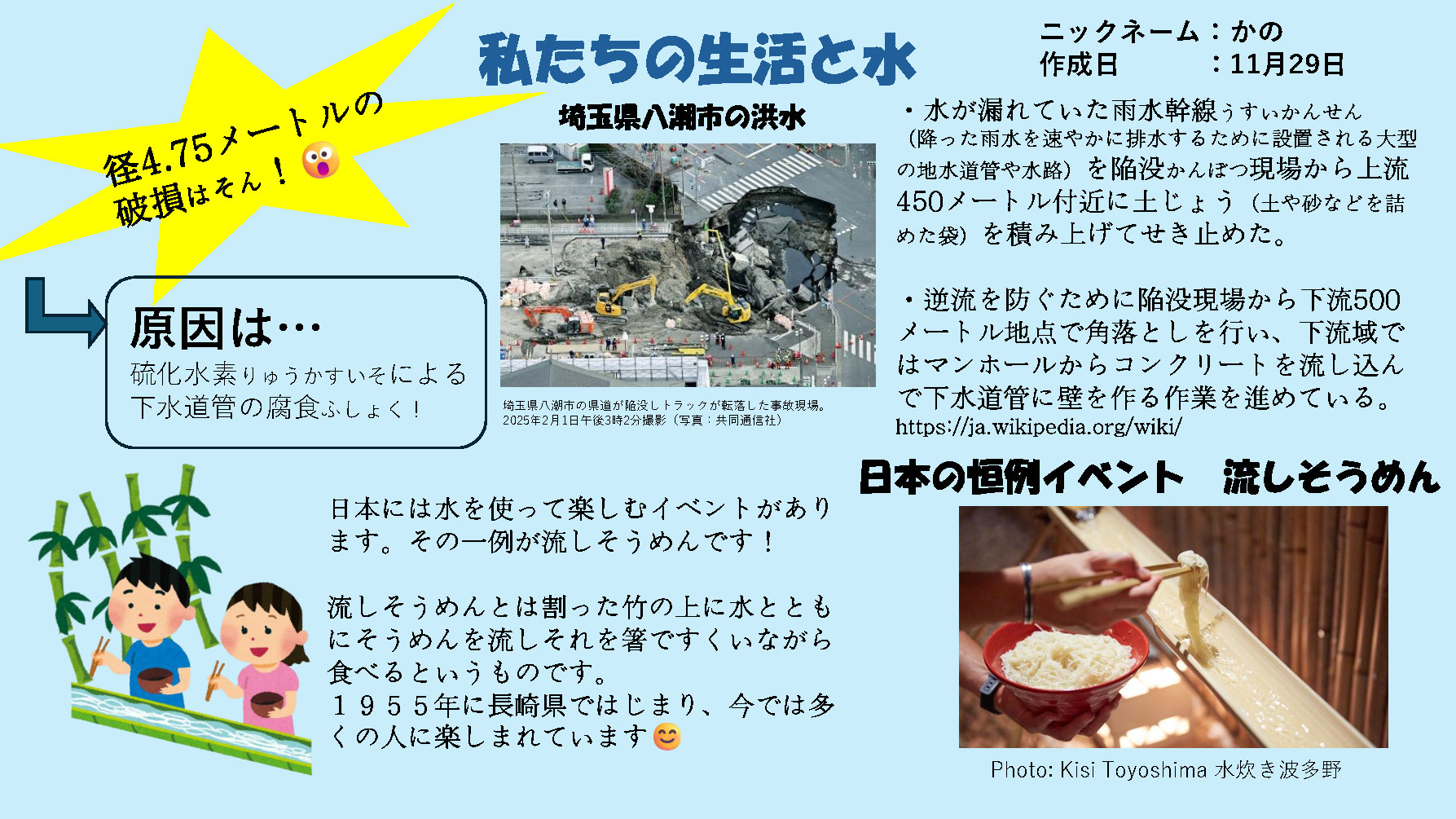
水道インフラ、道路陥没(どうろ かんぼつ)、洪水(こうずい)、雨水幹線(うすい かんせん)、下水道管(げすいどうかん)、管の腐食(ふしょく)と破損(はそん)、上流と下流(じょうりゅう かりゅう)、日本
- <ワンページャーの出典>
- 日経クロステック 20250218 埼玉・八潮市で大規模な道路陥没
- https://xtech.nikkei.com/atcl/nxt/mag/ncr/18/00158/020700048/
- 写真のキャプション:埼玉県八潮市の県道が陥没しトラックが転落した事故現場。2025年2月1日午後3時2分撮影(写真:共同通信社)
- そうめん
- https://www.shimabara-soumen.com/
- https://www.timeout.jp/tokyo/ja/restaurant/tokyo-soumen
- Photo: Kisi Toyoshima 水炊き波多野
- イラスト
- https://www.irasutoya.com/2013/06/blog-post_5508.html
- https://www.irasutoya.com/2012/12/blog-post_4960.html
- <自己紹介ビデオのテロップ>
- 自己紹介動画 お風呂と水
- 我が家ではお風呂が一日に最も多く水を使っています!
- 日本では毎日多くの人がお風呂につかる文化があります。
- お風呂の水は近くの大きな川から水を得て浄水場できれいにしたものが使われています。
- お風呂は体を芯から温めてくれ、心も安らげることができます。
- 一日に使う水の量
- お風呂・シャワー 300L
- 飲料水 1.2L
- 洗い物 20L×3
- 料理 2L
- トイレ 60L
- <自己紹介ビデオのテロップ>
- ポーイー
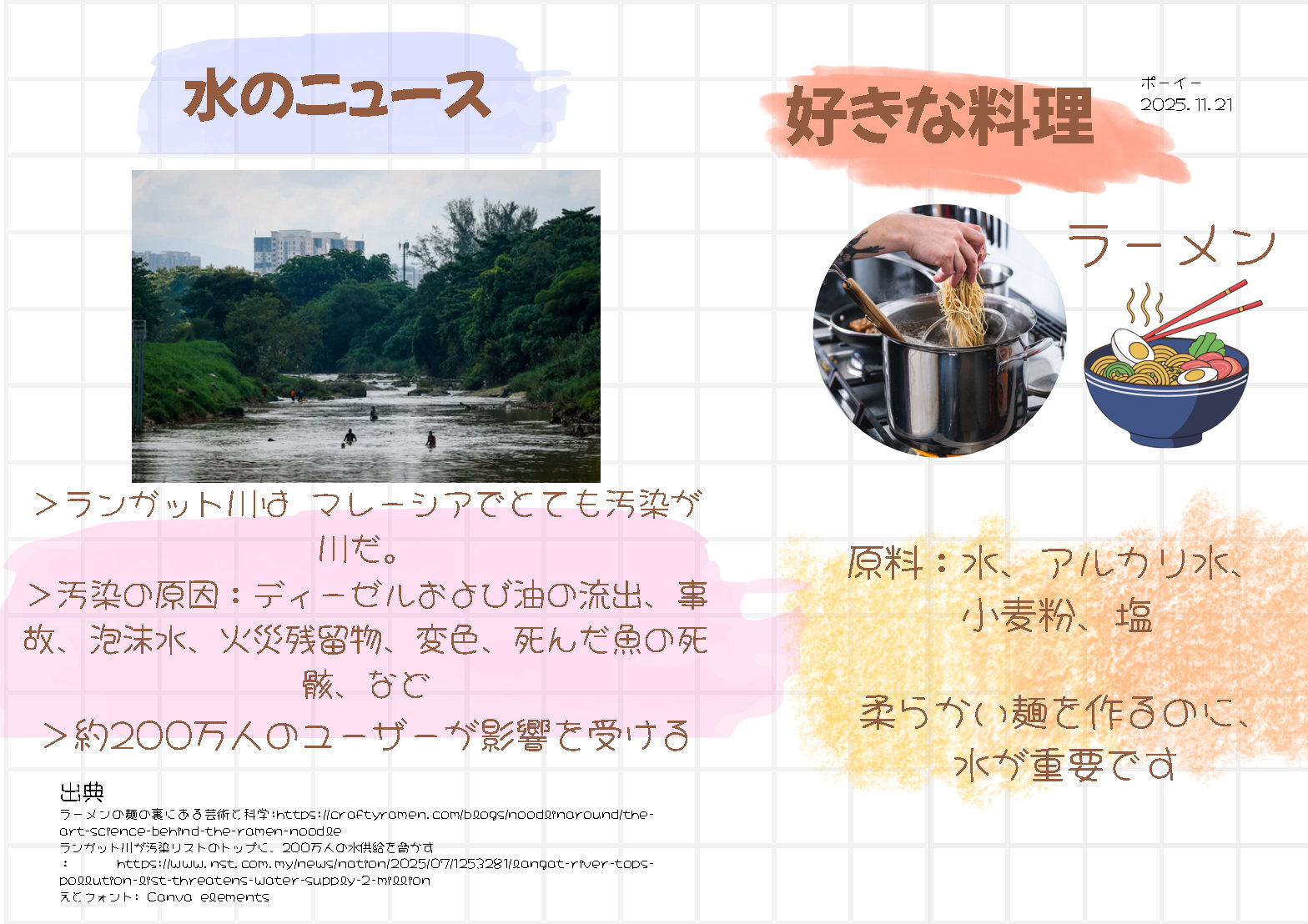
河川(かせん)、ランガット川、汚染(おせん)、汚染の原因、ディーゼルと油(あぶら)、泡沫水(ほうまつすい)、火災残留物(かさいざんりゅうぶつ)、魚の死骸(しがい)、多くの市民に影響(えいきょう)、マレーシア
- <ワンページャーの出展>
- The Art & Science Behind The Ramen Noodle
- https://craftyramen.com/blogs/noodlinaround/the-art-science-behind-the-ramen-noodle
- The Straits Times 20250731 Langat River tops pollution list, threatens water supply for 2 million
- https://www.nst.com.my/news/nation/2025/07/1253281/langat-river-tops-pollution-list-threatens-water-supply-2-million
- 絵とフォント: Canva elements
- <ワンページャーの出展>
- <自己紹介ビデオのナレーション>
- ポーイーの自己紹介ビデオ
- わたしの住んで所は海に近くない
- 家の水は近くの川から来ています
- 毎日沸騰した水を飲みます
- 机の前に座っている、水筒は机の上に置いてある
- 水が飲みやすくなる
- <自己紹介ビデオのテロップ>
- 私が1日に使う「水」の量
- 飲むこと≈2.5L
- 料理≈4L
- トイレ≈25L
- シャワー≈45L
- 皿洗い≈15L
- 合計≈91.5L
- <自己紹介ビデオのナレーション>
- りな
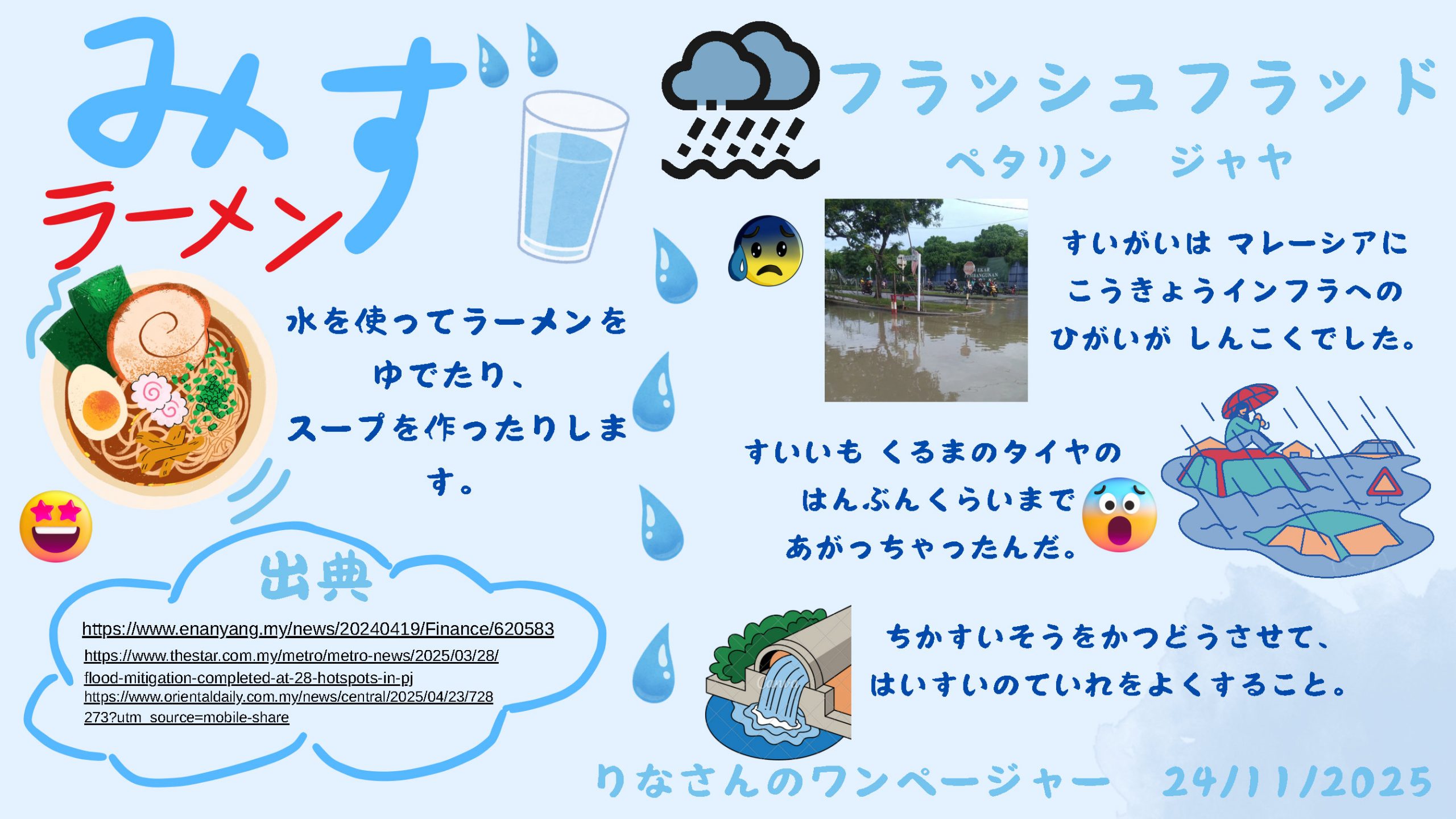
公共(こうきょう)インフラ、水害(すいがい)、洪水(こうずい)、経済的損失(けいざいてきそんしつ)、地下貯水槽(ちか ちょすいそう)、マレーシア
- <ワンページャーの出典>
- e南洋 20240419 公共设施破坏最严重 水灾3年损失70亿
- https://www.enanyang.my/news/20240419/Finance/620583
- The Star20250328 Flood mitigation completed at 28 hotspots in PJ
- https://www.thestar.com.my/metro/metro-news/2025/03/28/flood-mitigation-completed-at-28-hotspots-in-pj
- 東方日報 20250423 八打灵再也闪电水灾 李健聪促市政厅拟解决方案
- https://www.orientaldaily.com.my/news/central/2025/04/23/728273?utm_source=mobile-share
- <ワンページャーの出典>
- <自己紹介ビデオの出典>
- 動画 n2ddt films「Sungai Selangor Dam / Empangan – Kuala Kubu Bharu, Selangor,Malaysia – DJI Mavic Pro – Full HD 1080p」
- https://youtu.be/omzeOxFsiiA?si=-uU2HHeOQQh6DqvT
- <自己紹介ビデオの出典>
- <自己紹介ビデオのテロップ>
- セリナの自己紹介ビデオ
- これはセランゴールのダムで、
- ペタリンジャヤ地域の住民に水を供給しています。
- まず、ろ過した水をケトルに入れます。
- すでにろ過してありますが、
- 安全のために必ず沸騰させます。
- 沸騰させたあと、保温のために
- 一部の水を保温ポットに移します。
- 残った水は冷ましてからタンクに移します。
- よし!お気に入りのコップでお水を飲もう!
- 私が1日に使う「水」の量
- せんたく:42L
- 飲み物:14L
- 手洗い:20L
- シャワー:32L
- 食器洗い:25L
- トイレ:18L
- 合計:151L
- <自己紹介ビデオのテロップ>
- ジョーユ
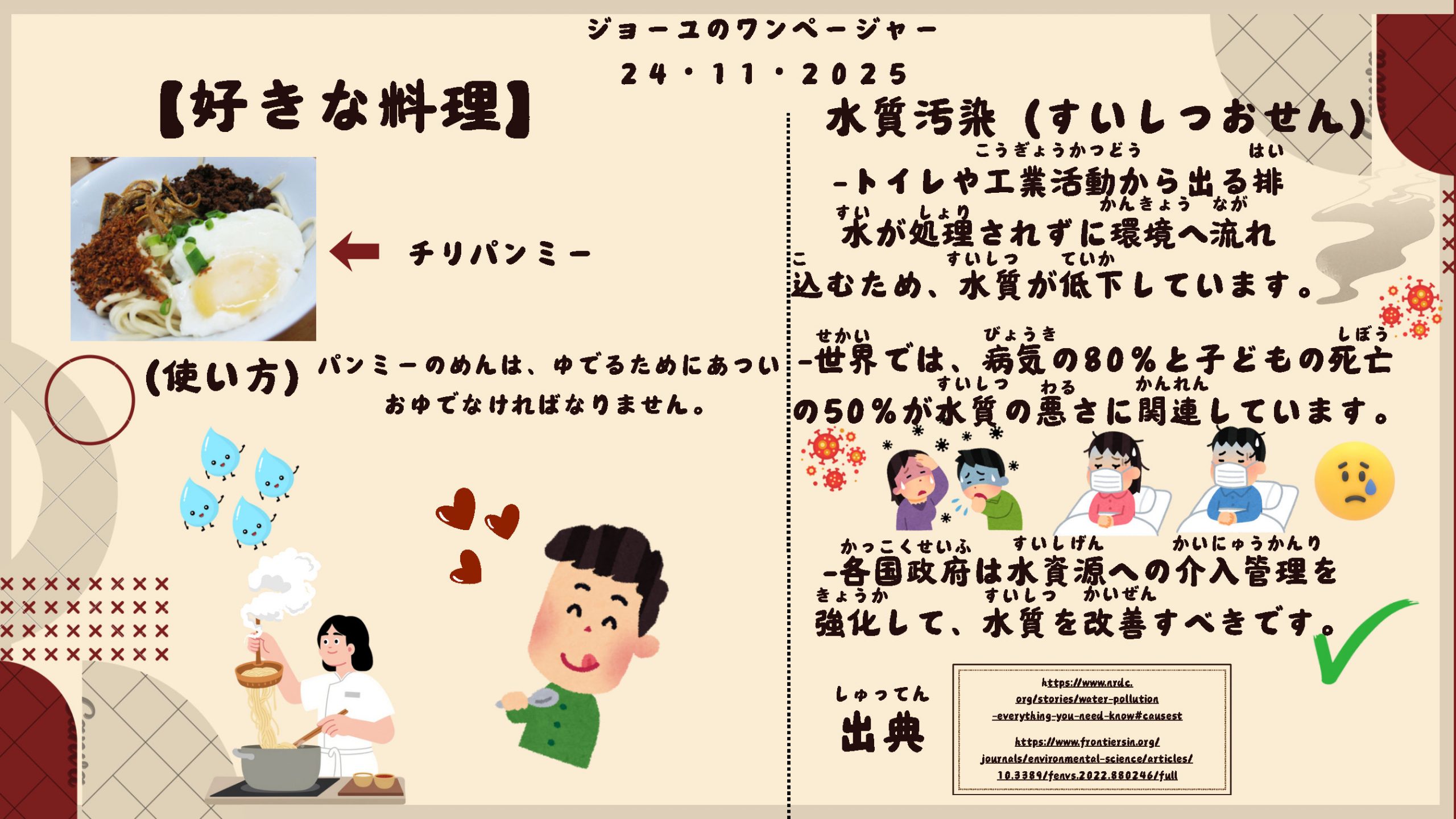
水質汚染(すいしつ おせん)、排水(はいすい)、トイレ、工業(こうぎょう)、病気、子どもの死亡(しぼう)、政府(せいふ)、介入管理(かいにゅう かんり)、世界
- <ワンページャーの出典>
- NRDC(Natural Resources Defense Council) 20230111 Water Pollution: Everything You Need to Know
- https://www.nrdc.org/stories/water-pollution-everything-you-need-know#causes
- Frontiers 20220630 Effects of Water Pollution on Human Health and Disease Heterogeneity: A Review
- https://www.frontiersin.org/journals/environmental-science/articles/10.3389/fenvs.2022.880246/full
- 絵とフォント
- Canva elements
- <ワンページャーの出典>
- <自己紹介ビデオのテロップ>
- ジョーユの自己紹介動画
- 私はセランゴールにすでいます。
- 私のしゅうでは、セメントー・ダムがいちばんのすいげんです。
- 私のすんでいるところにはかわがないので、そのダムに水をたよらなければなりません。
- 私のすんでいるところでは、プールやおんせん、こいのいけにきれいな水をつかっています。
- 私はすいどうの水をのみません。
- カックーのじょうすいきをつかっています。
- 私が1日に使う「水」の量
- 洗濯 ≈ 65L
- トイレ ≈ 50L
- シャワー ≈ 40L
- てあらい ≈ 10L
- 飲み物 ≈ 3L
- 合計 ≈ 168L
- <自己紹介ビデオのテロップ>
- ネラ
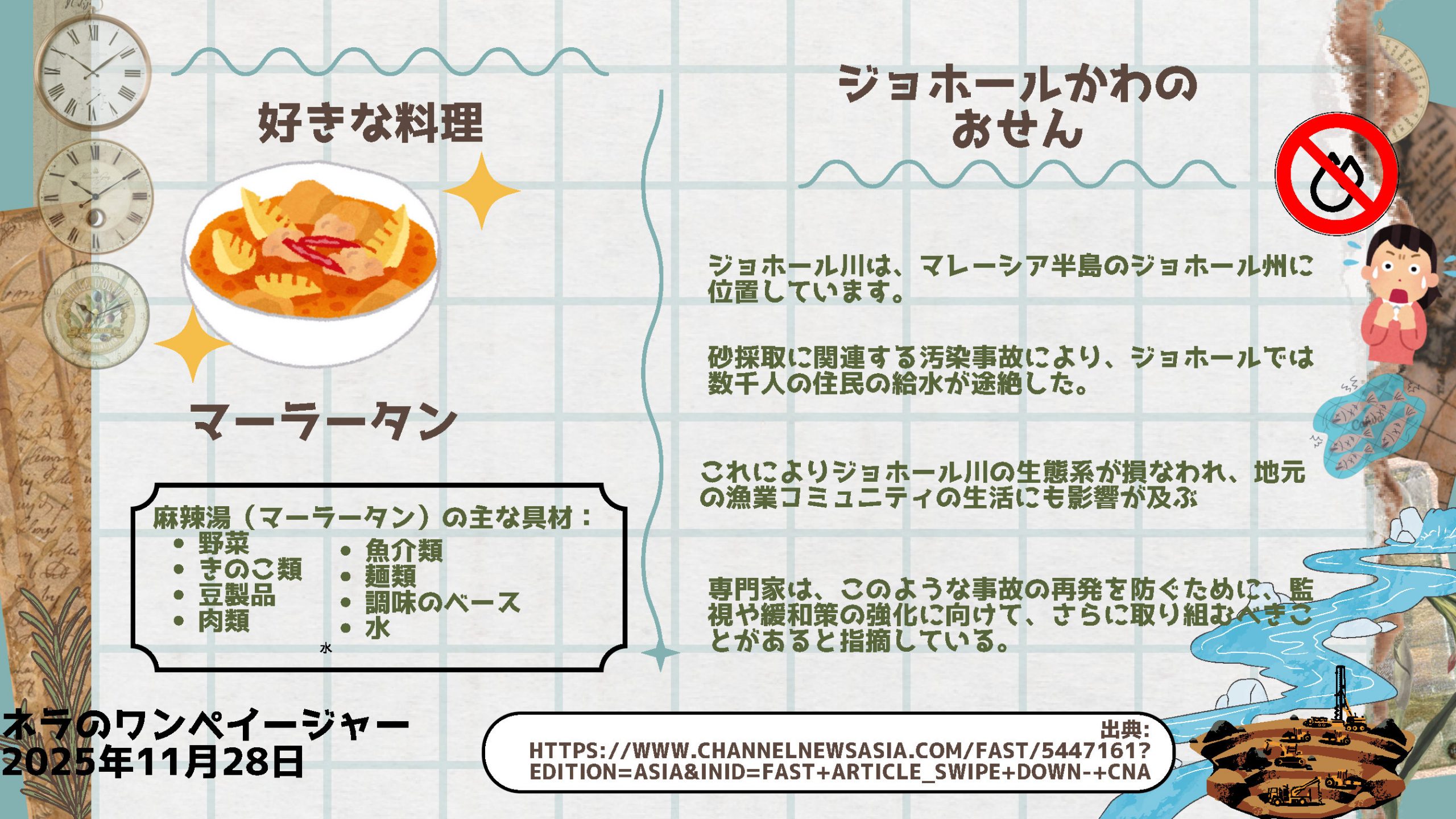
河川(かせん)、ジョホール川、河川汚染(かせん おせん)、砂採取(すな さいしゅ)、給水停止(きゅうすい ていし)、生態系(せいたいけい)、漁業(ぎょぎょう)、監視(かんし)、緩和策(かんわさく)、マレーシア
- <ワンページャーの出典>
- CNA 20251105 ‘Can’t even get 1 cent’: Residents’ livelihoods hit by Johor River pollution linked to sand mining
- https://www.channelnewsasia.com/fast/5447161?edition=asia
- https://www.channelnewsasia.com/asia/malaysia-johor-river-pollution-livelihoods-affected-5447161?fast=true
- <ワンページャーの出典>
- りんりん

河川(かせん)、湧き水(わきみず)、減少(げんしょう)、都市化(としか)、地中(ちちゅう)にしみこまない、水生生物(すいせいせいぶつ)、ホトケドジョウ、絶滅危惧種(ぜつめつきぐしゅ)、きれいな水、自然にかえす、日本
- <ワンページャーの出典>
- クラムチャウダーのレシピ
- https://www.kyounoryouri.jp/recipe/601807_
- <ワンページャーの出典>
- <自己紹介ビデオの出典>
- 東京都水道局「もっと 知りたい『水道』 のこと|よくある質問『一人 1 日どのくらいの水を使うのですか。』」 東京都水道局公式サイト(参照 20251221)
- https://www.waterworks.metro.tokyo.lg.jp/faq/qa-14
- <自己紹介ビデオの出典>
- <自己紹介ビデオのテロップ>
- こんにちはりんりんです
- 私は普段水道水を 使っています
- また、 外ではペットボトルの 水を 飲むこともあります。
- 飲み水以外に 私の家の近くには湧水が流れる 白子川があります!
- この 川には絶滅危惧種のホトケドジョウ もいます
- 次に
- 私の普段使っている 水の量について 紹介します
- 私は 1 日に 270 リットル消費しています
- 減らしていきたいです…
- ありがとうございました
- <自己紹介ビデオのテロップ>
- みん
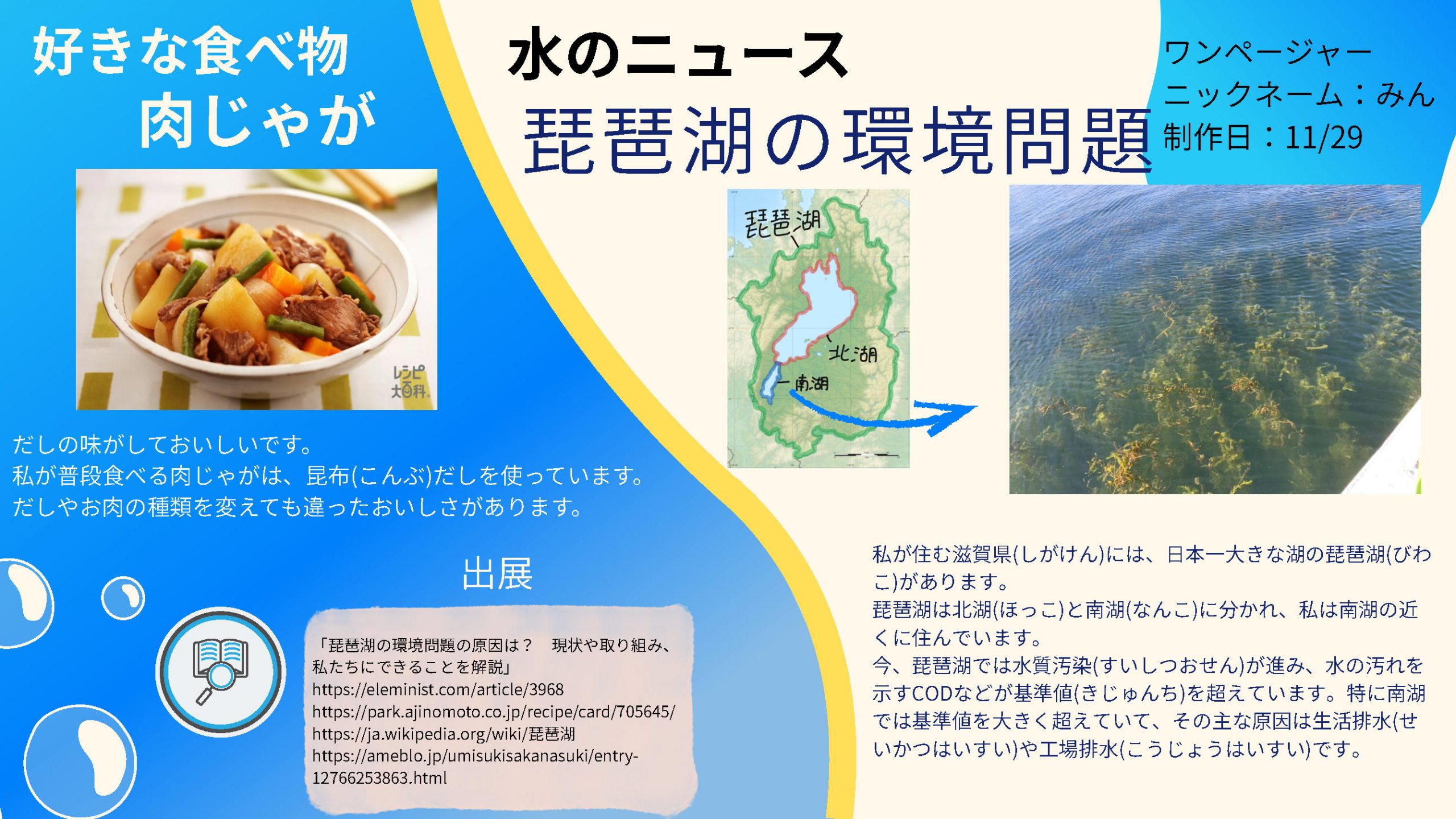
湖沼(こしょう)、琵琶湖(びわこ)、南湖(なんこ)、北湖(ほっこ)、水質汚染(すいしつ おせん)、COD、基準値(きじゅんち)、生活排水(せいかつはいすい)、工場排水(こうじょうはいすい)、日本
- <ワンページャーの出典>
- ELEMINIST 20241229 琵琶湖の環境問題の原因は? 現状や取り組み、私たちにできることを解説
- https://eleminist.com/article/3968
- 画像
- https://park.ajinomoto.co.jp/recipe/card/705645/
- https://ja.wikipedia.org/wiki/%E7%90%B5%E7%90%B6%E6%B9%96
- https://ameblo.jp/umisukisakanasuki/entry-12766253863.html
- <ワンページャーの出典>
- <自己紹介ビデオのテロップ>
- みんの自己紹介ビデオ
- 私の家ではウォーターサーバーを使っています。
- 私は、 朝起きたときやご飯を食べるときに一杯の水を飲みます。
- 最近はとても 寒いので、 冷たい水と 熱湯を合わせてぬるま 湯にして飲んでいます。
- 1 日に使う 水の量
- お風呂→120L
- トイレ→40L
- 飲料→2L
- その他(手洗い、 歯磨きなど)→30L
- 合計 192L
- <自己紹介ビデオのテロップ>
- クルマ
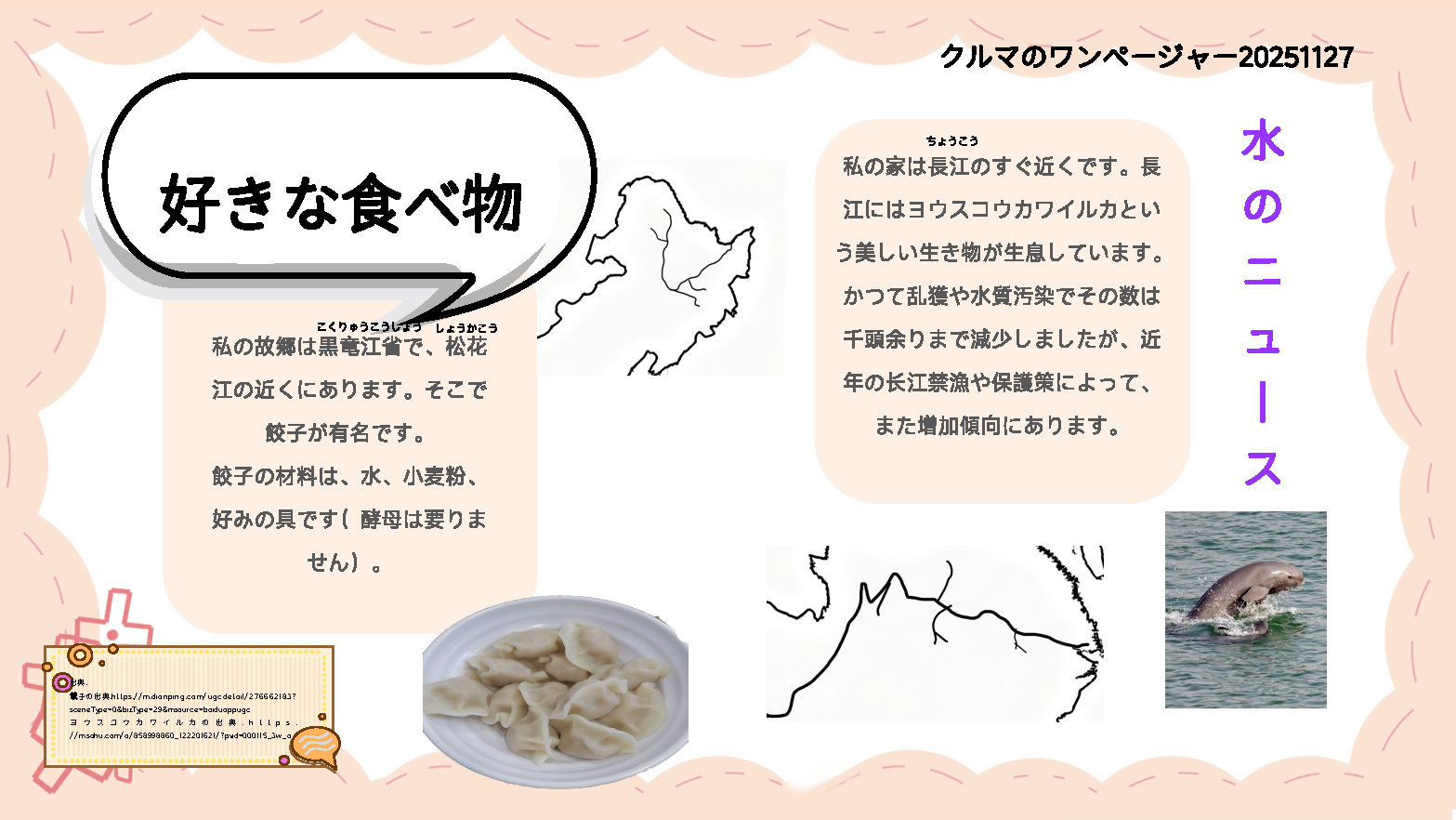
河川(かせん)、長江、水生生物(すいせい せいぶつ)、ヨウスコウカワイルカ、乱獲(らんかく)、水質汚染(すいしつ おせん)、減少(げんしょう)、禁漁(きんりょう)、保護(ほご)、増加(ぞうか)、中国
- <ワンページャーの出典>
- 央广网20241218 文化中国行·长江之歌丨微笑的江豚,从四千年前“游”来
- https://news.cnr.cn/native/gd/20241218/t20241218_527013609.shtml
- <自己紹介ビデオのテロップ>
- クルマの自己紹介ビデオ
- 私の身近にある水は、中国最長の川――長江(ちょうこう)です。
- 武漢(ぶかん)は長江に沿って発展した都市で、私たちが普口飲んだり使ったりする水も、ほとんどが長江から来ています。
- 私たちの日常生活では、よく水を沸かしてから飲みます。
- 同時に、水に茶葉(緑茶(りょくちゃ)、紅茶(こうちゃ)、ジャスミン茶など)を加えてお茶を淹れることも、とても人気のある習慣です。
- 私自身は紅茶が大好きです。
- 私が1日に使う「水」の量:
- 飲む: 0.75L(魔法瓶の一杯)×2杯以上 = 約2L
- 炊事と食事洗い: 約30L
- シャワーや手洗い: 約75L
- トイレ: 約35L
- その他(例えば服の洗濯): 約30L
- 総計: 172L
- <自己紹介ビデオのテロップ>
- 桃
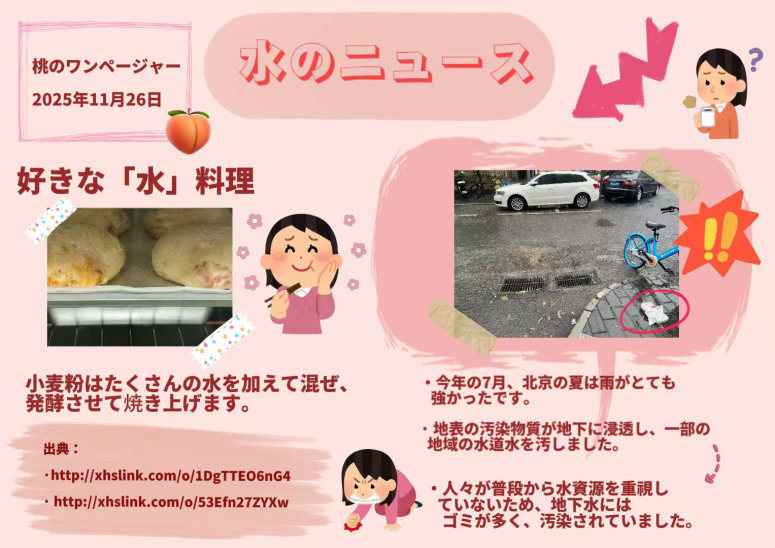
北京、2025年7月、多雨(たう)、地表の汚染物質(おせんぶっしつ)、地下浸透(ちかしんとう)、水道の汚染(すいどう おせん)、ゴミ、中国
- 自己紹介ビデオ(YouTube)へリンク
- <ワンページャーの出典>
- <ワンページャーの追記>
- 好きな料理の名前:チャパタパン
- 出典(20251221更新)
- 新浪新聞 250728 首席预报员:#北京今夜强降雨或伴七八级大风#
- https://weibo.com/2028810631/5193504647023488
- China Environment News (中国环境报) 250718 海淀:早部署严排查 科技护水保安全丨战汛期 保水质
- https://cenews.com.cn/news.html?aid=1518151
- China Environment News (中国环境报) 250720 北京石景山构建“三重防护网”,筑牢安全屏障丨战汛期 保水质
- https://cenews.com.cn/news.html?aid=1518403
- <自己紹介ビデオのテロップ>
- 桃の自己紹介ビデオテキスト
- 私は中国の北京に住んでいます
- 北京の生活用水はみな密雲(みつうん)ダムから来ています
- 比較的乾燥している時期に、政府は「南水北調(なんすいほくちょう)」プロジェクトを通じて可用水量を増やします
- 私は毎日何度も水を使って、 例えば手を洗います
- 水を飲んだり、ペットにご飯を作ったりします
- <自己紹介ビデオのテロップ>
- 月(つき)
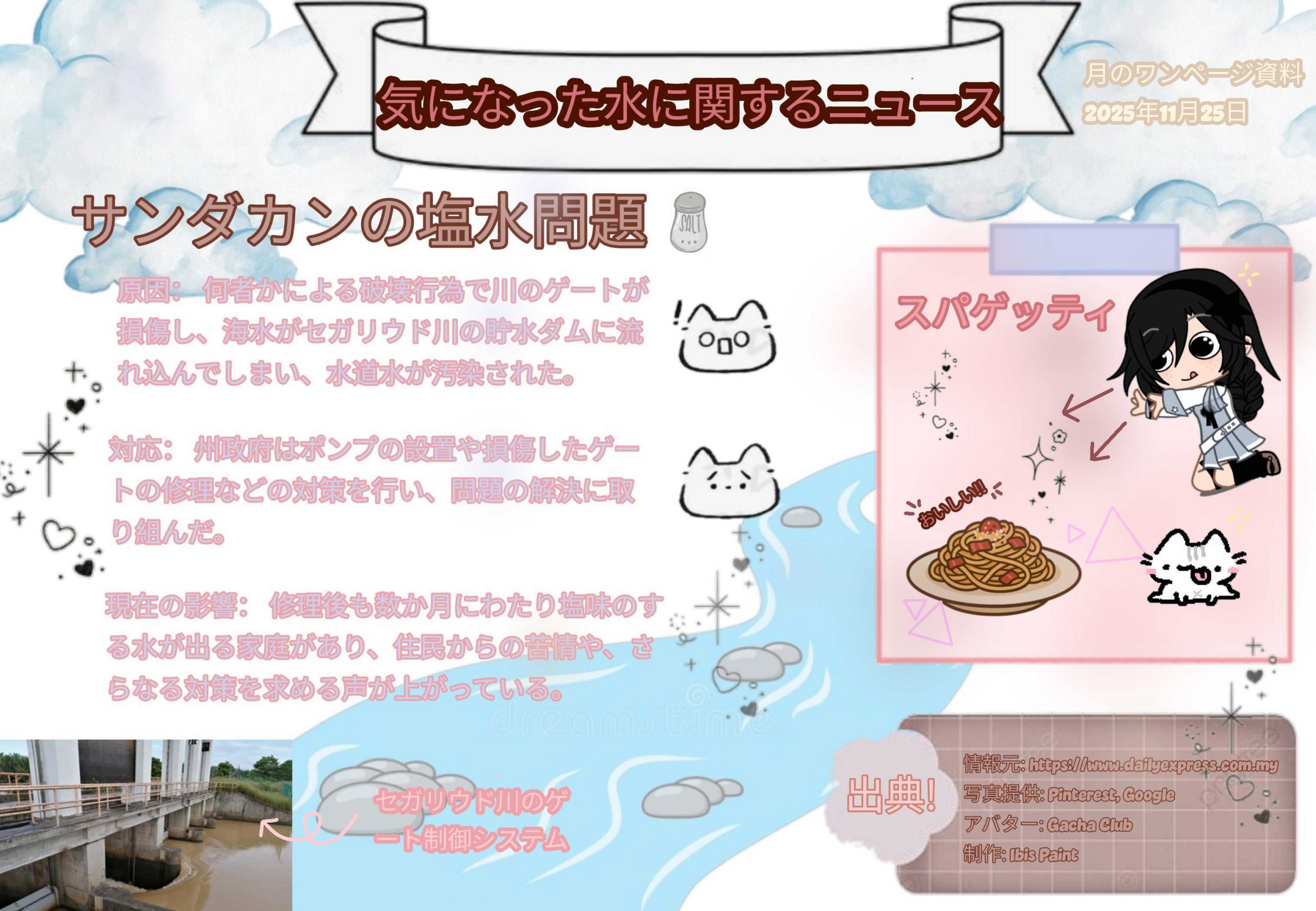
河川(かせん)、セガリウド川、破壊行為(はかいこうい)、ゲートの損傷(そんしょう)、貯水(ちょすい)ダム、海水/塩水混入(えんすい こんにゅう)、問題の長期化(ちょうきか)、マレーシア
- <ワンページャーの出展など>
- The Daily Express 20230506 Sandakan’s salty water problem to be resolved in stages
- https://www.dailyexpress.com.my/news/212288/sandakan-s-salty-water-problem-to-be-resolved-in-stages/
- News’ Wav 20230506 Sandakan’s salty water problem to be resolved in stages
- https://newswav.com/A2305_73pv2b?s=A_Jn7LVs2&language=en
- 写真提供
- 川ゲート制御システムの写真
- https://share.google/oUCb9rbsjfPR7XZog
- アバター
- Gacha Club https://lunime.itch.io/gacha-club
- 制作
- Ibis Paint
- <ワンページャーの出展など>
- <自己紹介ビデオのテロップ>
- サンダカンの水道供給は主にセガリウド浄水場から行われており、さらにキナバタンガン川やシブガ浄水場からの供給も加わっています。
- また、サンダカンの一部地域では、ボーリングによって深い帯水層から地下水を利用しています。
- 私の家には雨水タンクがあり、植物への水やりや洗濯、そして車を洗うために使われています。
- その水はろ過されていないため、飲むことは安全ではありません。
- 水圧が低い場合は、給水ポンプを使って予備タンクから水を取っています。
- これは予備タンクから水を取るためのスイッチです。
- マレーシアでは、水道水はそのまま飲みません。
- 私たちは浄水器を使っています。
- 水道水も飲むことはできますが、沸かした場合だけです。
- 断水に備えて、家にはたくさんのミネラルウォーターを用意しています。
- <自己紹介ビデオのテロップ>
- おみお
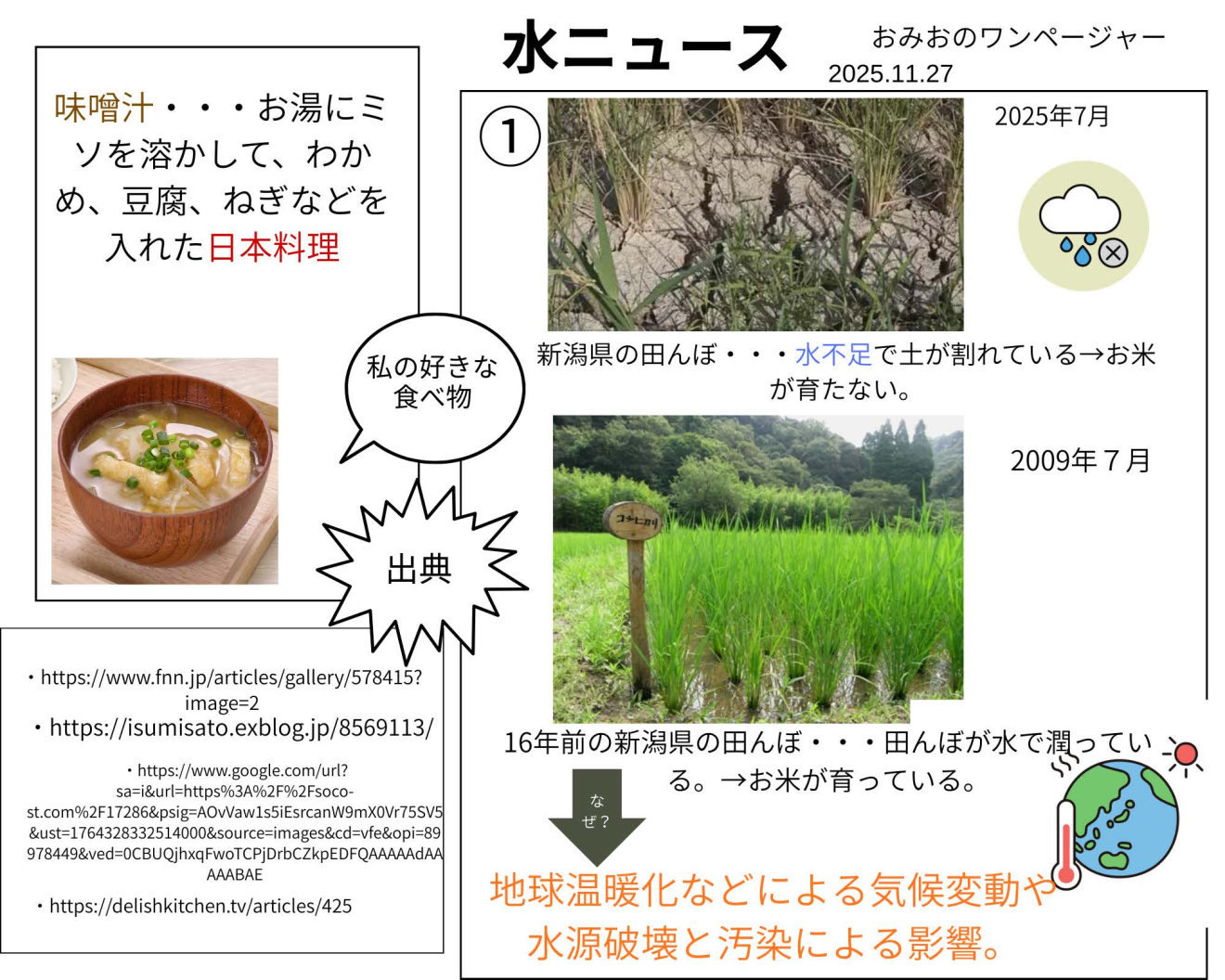
水不足(みずぶそく)、地球温暖化(ちきゅうおんだんか)、気候変動(きこうへんどう)、水源(すいげん)、破壊(はかい)、汚染(おせん)、少雨(しょうう)、田んぼ、稲作(いなさく)、米が育たない、新潟県(にいがたけん)、2009年(16年前)と2025年、日本
- 自己紹介ビデオ(YouTube)へリンク
- りえ
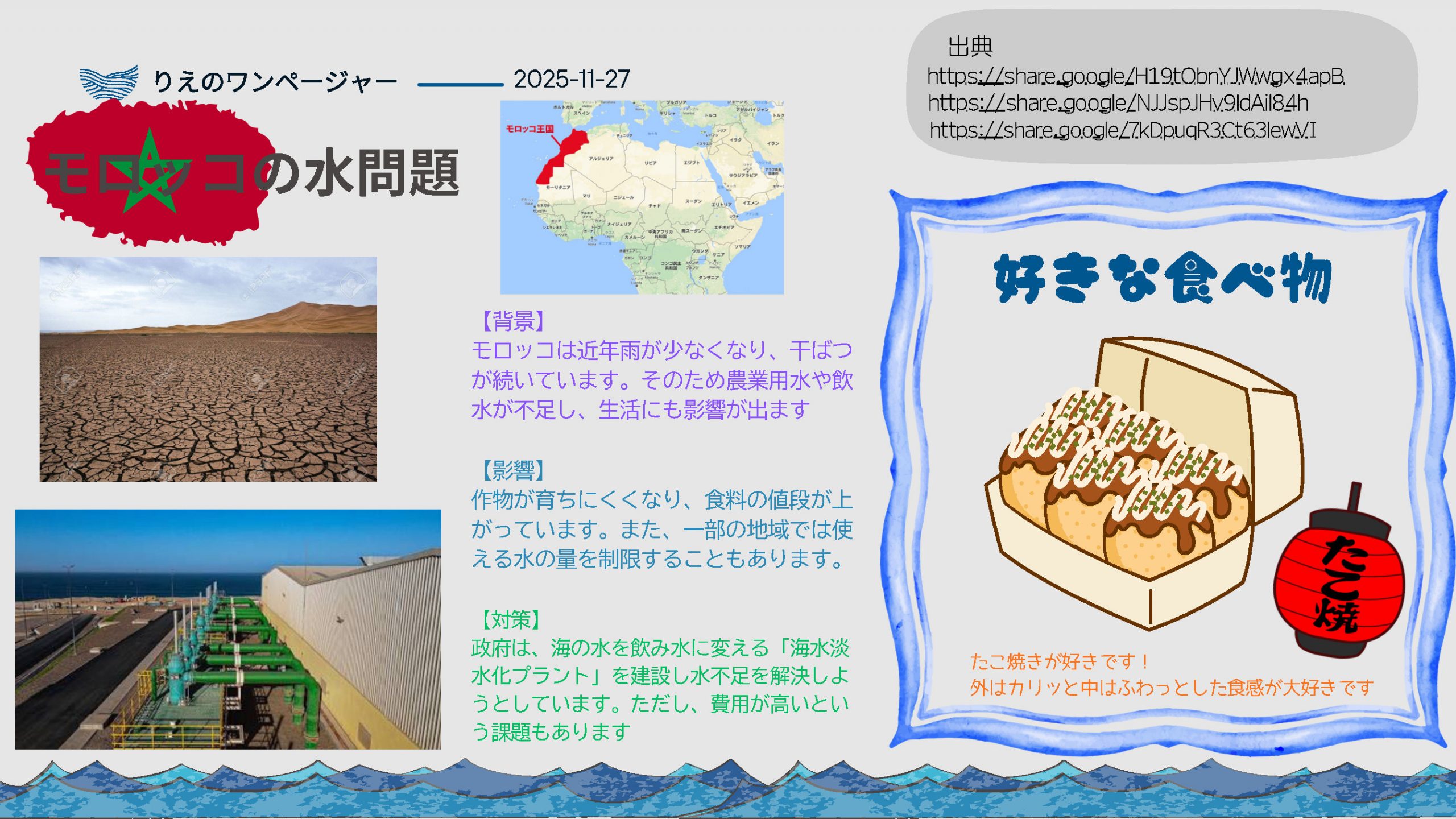
少雨(しょうう)、干ばつ、農業用水(のうぎょうようすい)、飲水(いんすい)、水不足(みずぶそく)、食料価格(しょくりょうかかく)の上昇(じょうしょう)、水使用の制限(せいげん)、海水淡水化(かいすいたんすいか)プラント、費用負担(ひようふたん)、モロッコ
- <自己紹介ビデオの出典>
- イラストと写真
- https://share.google/iArwj8YNv41myN81y
- https://share.google/r8UmSWrp7uqib8JoO
- 音楽「So Cute」Kim Sung Hwan(CupCat)
- <自己紹介ビデオの出典>
- <自己紹介ビデオのテロップ>
- りえの自己紹介ビデオ
- 私は日本の滋賀県野洲市に住んでいます!
- 自然が近くて暮らしやすい街です!
- 私がいつも飲んでいる水は水道水とウォーターサーバーです!
- 野洲市の水道水は地下水や琵琶湖の水を浄水したものです。
- 私が使う水の量
- シャワー・お風呂:約100L
- トイレ:約20L
- 洗面・手洗い:約8L
- 飲料:約1.5L
- 料理:約4L
- 洗濯:約50L
- 皿洗い・掃除:約15L
- <自己紹介ビデオのテロップ>
- 月曜日
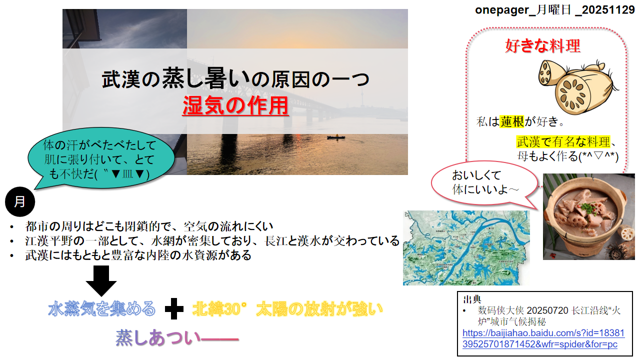
武漢、蒸し暑さ(むしあつさ)、湿気(しっけ)/水蒸気(すいじょうき)、地形(ちけい)、内陸(ないりく)、太陽放射(たいよう ほうしゃ)、中国
- <ワンページャーの出典>
- 数码侠大侠 20250720 长江沿线“火炉”城市气候揭秘
- https://baijiahao.baidu.com/s?id=1838139525701871452&wfr=spider&for=pc
- <ワンページャーの出典>
- <自己紹介ビデオのナレーション>
- 皆さん、こんにちは。私はげつようび。
- 私、最初のテーマは わたしが飲んでいる「水」 だ。
- 中国には、飲んでいる水は沸騰(ふっとう)させるから、軟水(なんすい)に属(ぞく)す。
- そのようにして、水はもっと安全し、体にいい。
- 生活において、用水量が多い。
- 私自分では、お風呂に入って使う水は110リットルだ。
- 他の人より驚くべき数字だ。
- <自己紹介ビデオのナレーション>
- 葉子
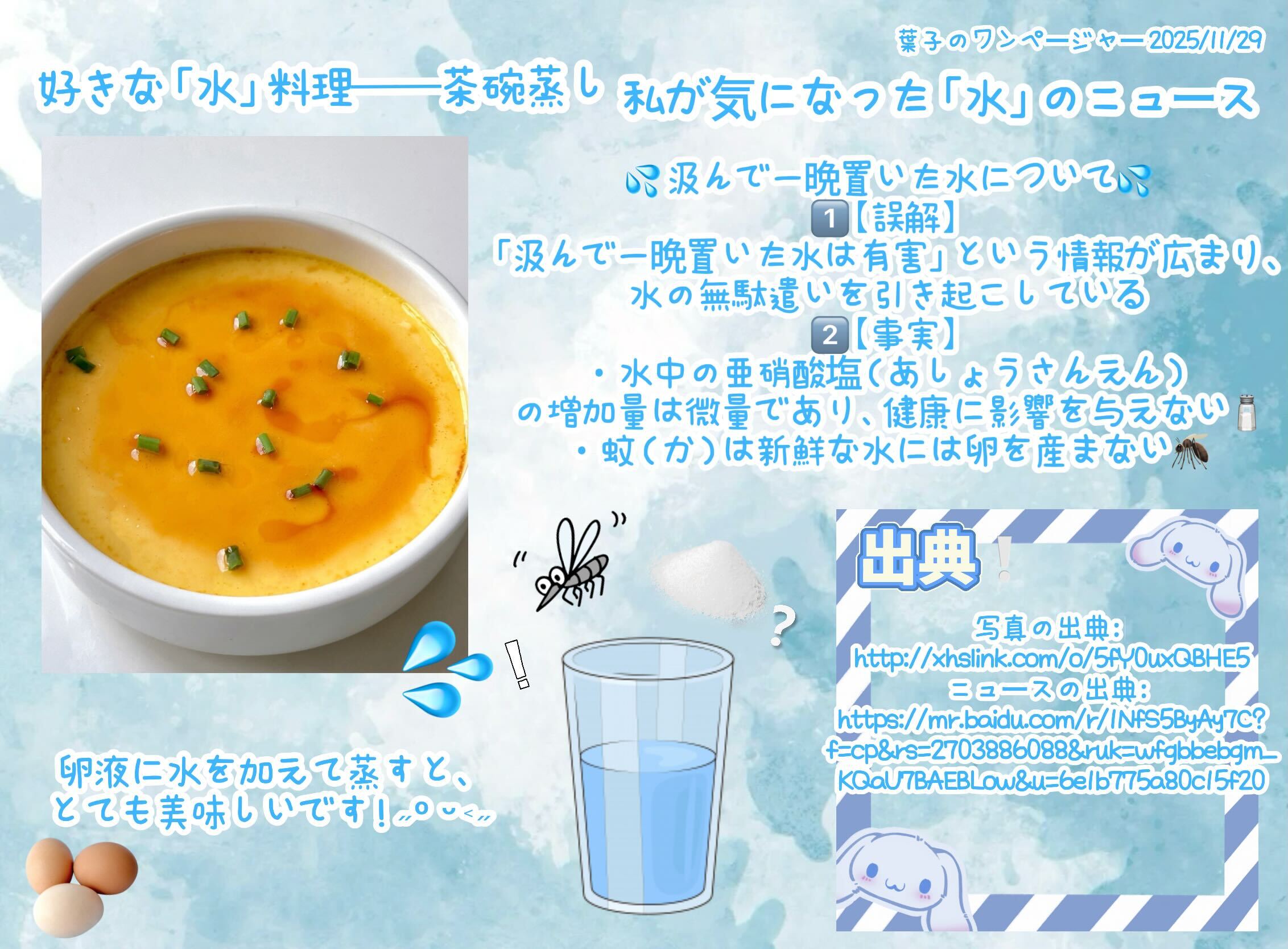
デマの流布(るふ)、汲み置いた水(くみおいた みず)、有害(ゆうがい)、亜硝酸塩(あしょうさんえん)、蚊(か)、中国
- 自己紹介ビデオ(YouTube)へリンク
- <自己紹介ビデオの出典>
- 長江のビデオ
- http://xhslink.com/o/3D760Vlqx5t
- 净水器のビデオ
- http://xhslink.com/o/7UyIbo3K7ks
- 水用量(中华人民共和国水利部)
- http://www.mwr.gov.cn/sj/tjgb/szygb/202312/t20231218 0697105.html
- 武漢の水用量(武漢水利集団有限公司)
- http://www.whwater.com/
- <自己紹介ビデオの出典>
- <自己紹介ビデオのテロップ>
- 私の周りにある「水」、それは中国一番長い川——長江です。
- 私が住んでいる町——武漢は、この大河のほとりに発展してきました。
- これは長江の「水」の風景です。
- でも、飲み物は日本と違い、水道水をそのまま飲みません。
- 安全のために、必ず沸かしてから飲むのが、私たちの日常です。
- 近年では、浄水器を持っている家も増え、特に沸かさずに飲めるようになりました。
- また、外出先では、鉱泉水を買って飲むのも、とても一般的です。
- 私が1日に使う「水」の量
- ①飲む 2L
- ②シャワー 35L
- ③炊事 40L
- ④トイレ 20L
- ⑤その他 15L
- 合計112Lです
- <自己紹介ビデオのテロップ>
- トニ

水道水(すいどうすい)、変色(へんしょく)、悪臭(あくしゅう)、中水再利用(ちゅうすいさいりよう)システム、管理会社(かんりがいしゃ)、違反(いはん)、2025年夏、北京、豪雨災害(ごううさいがい)、中国
- 自己紹介ビデオ(YouTube)へリンク
- <ワンページャーの出典>
- 今日头条 20251126 “汇学府自来水发黄发臭多日”续|有人违规接管污染供水设施?瓯海执法已介入调查
- https://m.toutiao.com/group/7576866306218033699/?Upstream_biz=doubao
- <ワンページャーの出典>
- <自己紹介ビデオのテロップ>
- 私の町の人口は多いけど、水資源が不足です
- そこで、政府は「南水北調(なんすいほくちょう)」という計画を立て、南の水をパイプラインで北に運ぶようにしました
- それに、希少な水資源を補足しています
- 水が蛇口から流して、バケツに入れます
- そして、ボタンをクリックして、水を約30秒加熱します
- その後、水が水筒からカップに入れて、飲むごとができます
- <自己紹介ビデオのテロップ>
- しずく
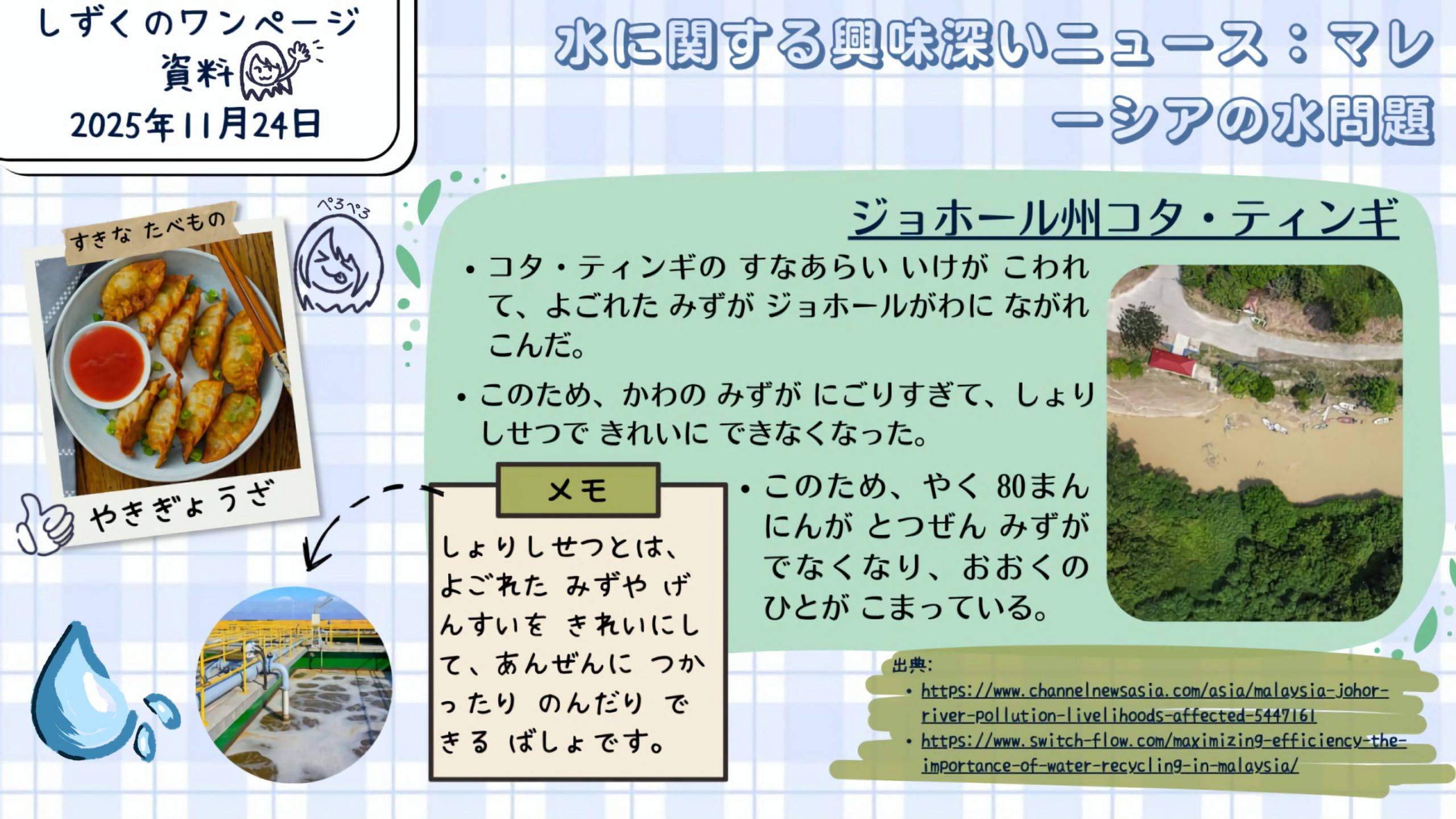
河川(かせん)、事故(じこ)、砂採掘(すなさいくつ)、砂洗い池、砂の流入(りゅうにゅう)、水質汚染(すいしつ おせん)、浄水処理施設(じょうすいしょり しせつ)、処理能力(しょりのうりょく)、下流の被害(ひがい)、マレーシア
- <ワンページャーの出展>
- CNA 20251105 ‘Can’t even get 1 cent’: Residents’ livelihoods hit by Johor River pollution linked to sand mining
- https://www.channelnewsasia.com/asia/malaysia-johor-river-Pollution-livelihoods-affected-5447161
- 水の処理について(Switch Flow社)
- https://www.switch-flow.com/maximizing-efficiency-the-importance-of-water-recycling-in-malaysia/
- <ワンページャーの出展>
- <自己紹介ビデオのテロップ>
- しずくの自己紹介ビデオ
- わたしのすんでいるところでは、かわなどのひょうりゅうすいがいちばんのみずのしげんです。
- わたしはサバ州にすんでいます。
- サバ州のおもなすいげんはかわです。
- マレーシアでは、すいどうすいをのまないです。
- わたしたちは、コウェイのようなウォーターサーバをつかってのみます。
- わたしは、みずがでないときのために、 みずのぼとるをぱっくでかいます。
- 私が使用する水の量
- 洗濯(せんたく) – 57L
- シャワー-45L
- トイレ-20L
- 飲料水(いんりょうすい) – 5L
- 手洗い(てあらい) – 2L
- 合計: 129L
- <自己紹介ビデオのテロップ>
大学生リーダー
- みっちゃん
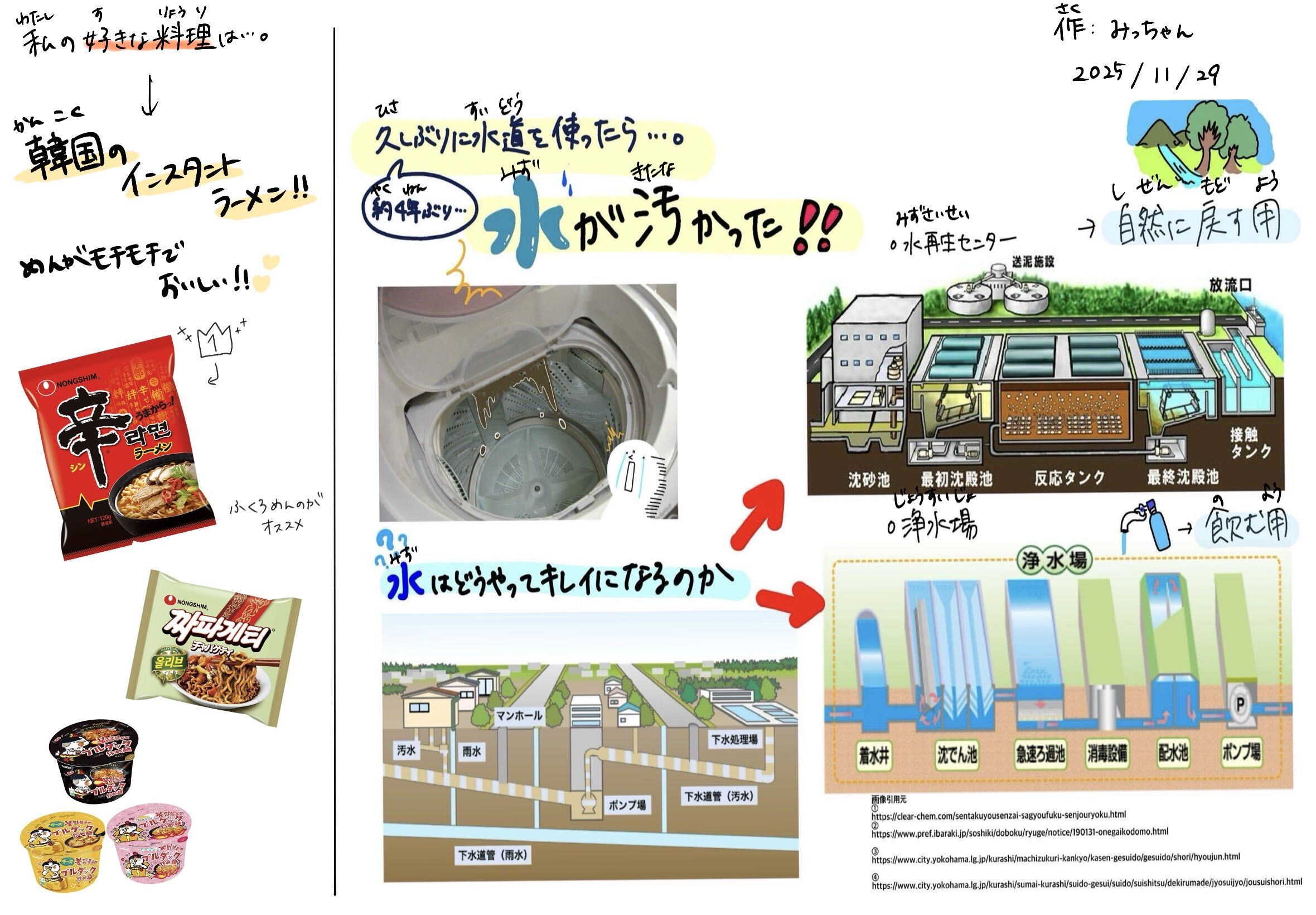
- <ワンページャーの出典>
- ①クリヤケミカル株式会社 洗濯槽の洗い方~作業服の頑固な汚れはクリヤケミカル株式会社の洗濯用洗剤で~
- https://clear-chem.com/sentakuyousenzai-sagyoufuku-senjouryoku.html
- ②茨城県 下水道(げすいどう)のしくみと下水処理場(げすいしょりじょう)からのおねがい
- https://www.pref.ibaraki.jp/soshiki/doboku/ryuge/notice/190131-onegaikodomo.html
- ③神奈川県横浜市 下水処理のしくみ
- https://www.city.yokohama.lg.jp/kurashi/machizukuri-kankyo/kasen-gesuido/gesuido/shori/hyoujun.html
- ④神奈川県横浜市 浄水場の処理工程
- https://www.city.yokohama.lg.jp/kurashi/sumai-kurashi/suido-gesui/suido/suishitsu/dekirumade/jyosuijyo/jousuishori.html
- <ワンページャーの出典>
- <自己紹介ビデオの出典>
- <自己紹介ビデオのテロップ>
- 私はインドアなので
- 基本的に家でゆっくりすることが好きです。
- 恐らく家で一番水を使っているのはトイレかお風呂です。
- トイレを見せるのも良くないので謎にシャワーをお届け。
- 水は飲みません。
- 水道水は味が苦手です。
- お金持ちになったら全部ジュースで生活してみせます。
- おわり
- 変な自己紹介ビデオになってしまいました( ; ; )
- これからよろしくお願いします!(^^)V
- <自己紹介ビデオのテロップ>
- ゆうかさん
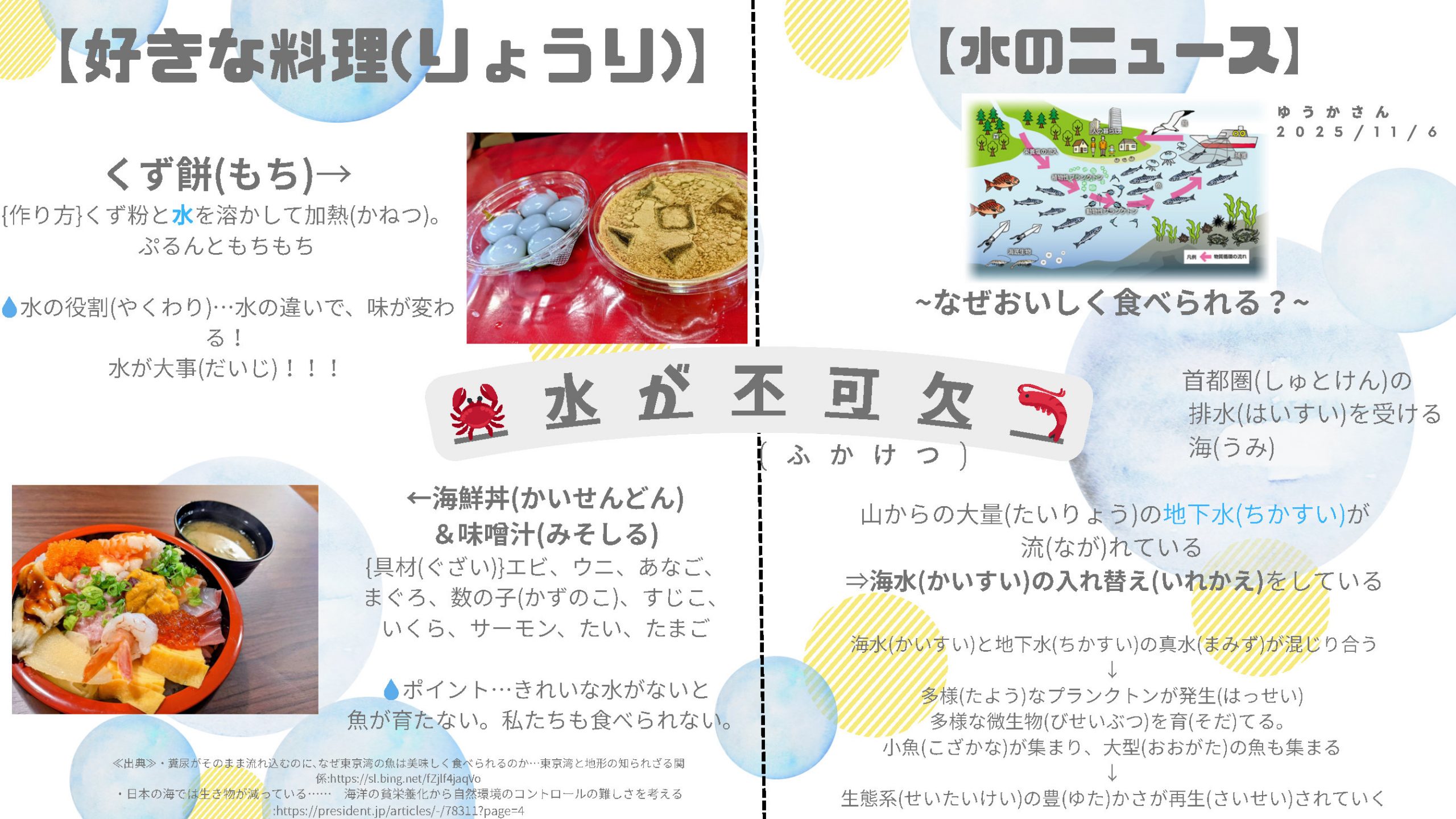
- 自己紹介ビデオ(YouTube)へリンク
- ざいさん
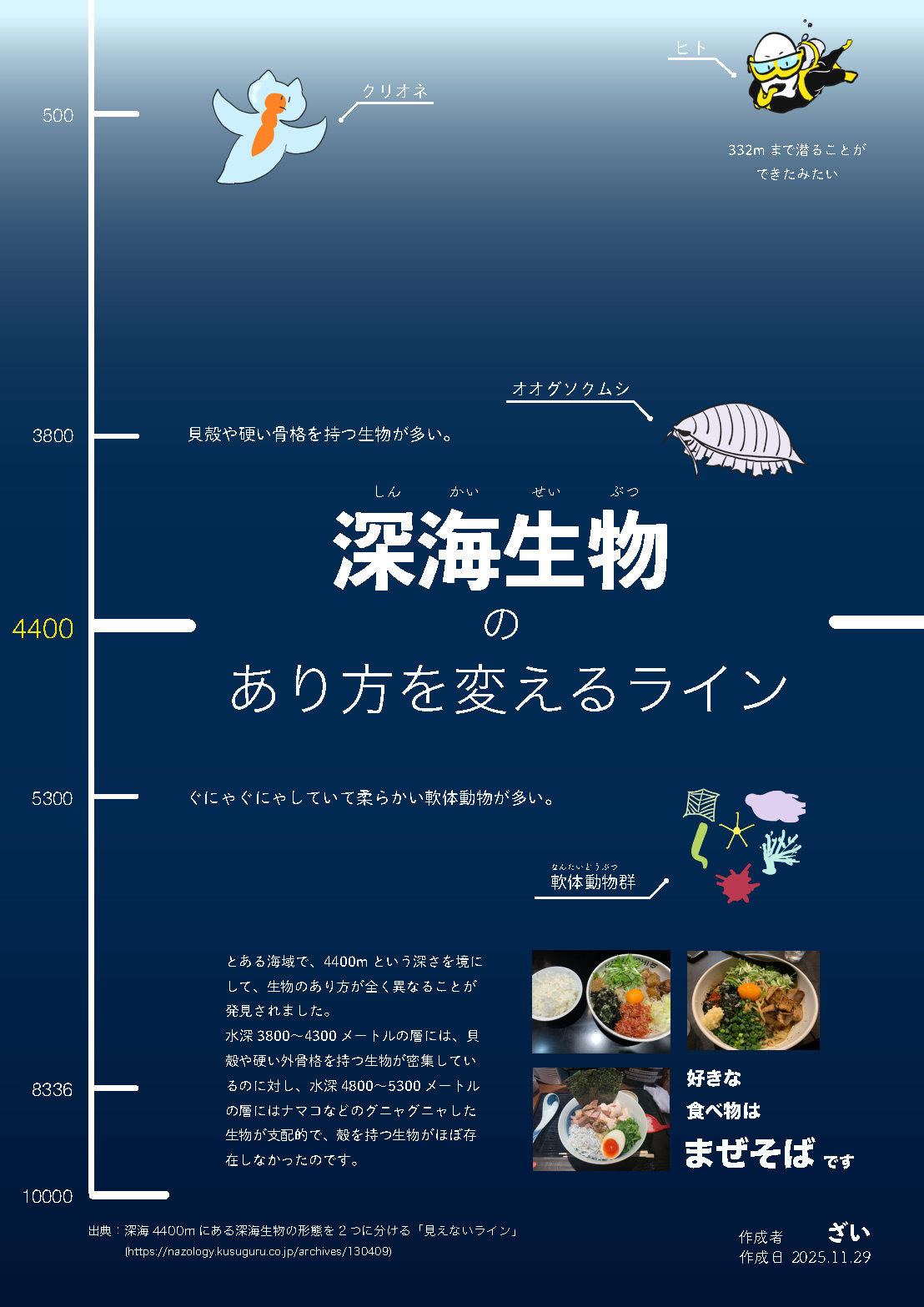
- <ワンページャーの出典>
- ナゾロジー 20230726 深海4400mにある深海生物の形態を2つに分ける「見えないライン」
- https://nazology.kusuguru.co.jp/archives/130409
- <ワンページャーの出典>
- <自己紹介ビデオのテロップ>
- こんにちは、ざいです
- 水道水をそのまま飲むことはあまりありません
- やかんでお湯を沸かして紅茶を飲みます
- 今日はハーブティーを飲みました
- 少しおしゃれになった気分です
- 1日に使う水の量
- お風呂200L
- トイレ30L
- 手洗い等4L
- 飲み物3L
- 合計236L
- <自己紹介ビデオのテロップ>
- さっちゃん
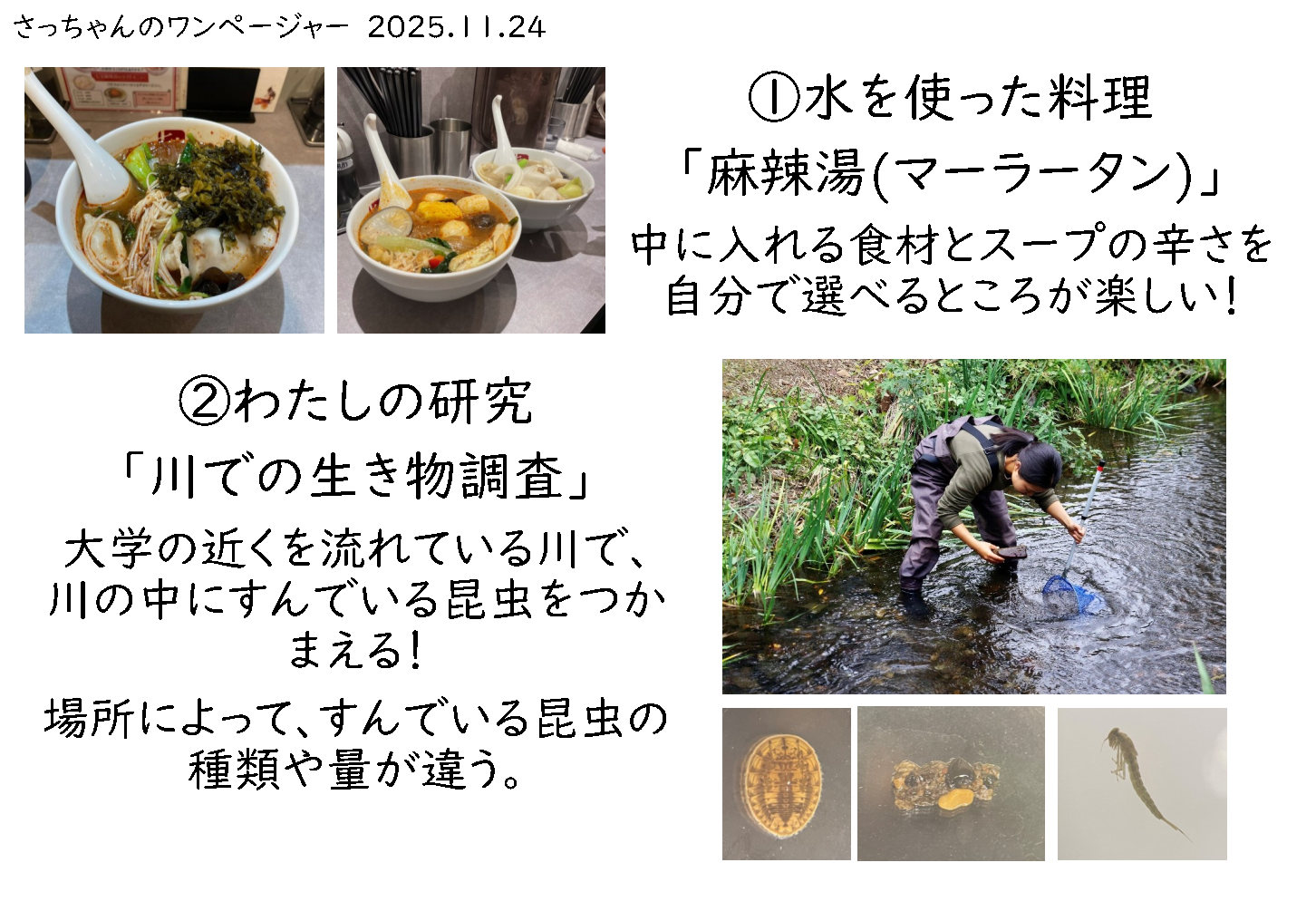
- さらさん
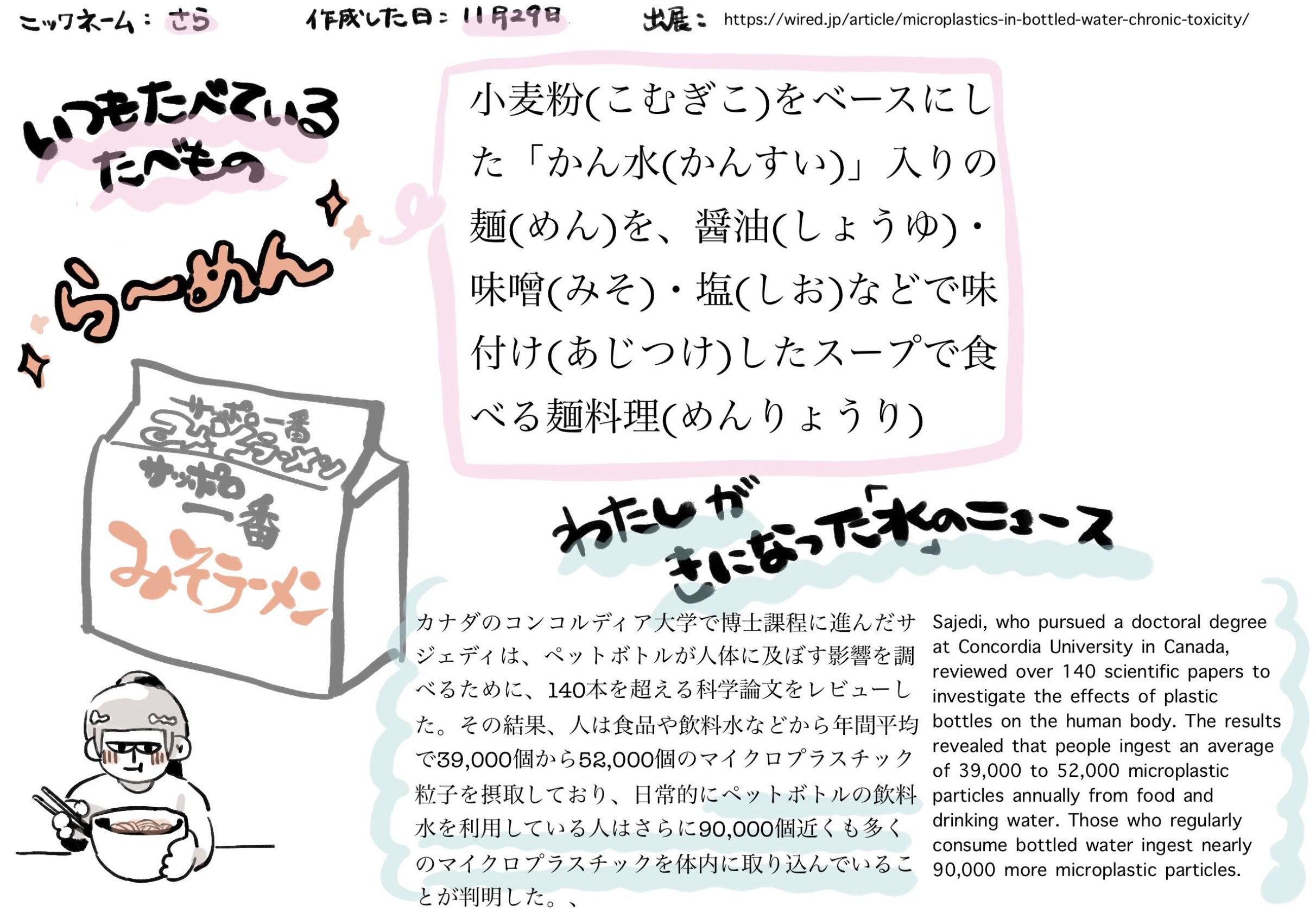
- <ワンページャーの出典>
- WIRED 20251027 ペットボトルの水を日常的に飲む人は、マイクロプラスチックを年間90,000個も多く摂取している
- https://wired.jp/article/microplastics-in-bottled-water-chronic-toxicity/
- <ワンページャーの出典>
- <自己紹介ビデオのナレーション>
- こんにちは。 私はサラです。
- 私が普段飲んでいる水は、ペットボトルの飲料水か、沸騰させたお湯を、冷やして、この中に入れて普段飲んでいます。
- 1日に使う水の量は、こんな感じになりました。
- <自己紹介ビデオのテロップ>
- 歯みがき 30L
- 手洗い、洗面 10L
- シャワー 50L
- 皿洗い 40L
- トイレ 50L
- 洗たく 70L
- <自己紹介ビデオのナレーション>
- もくもくさん
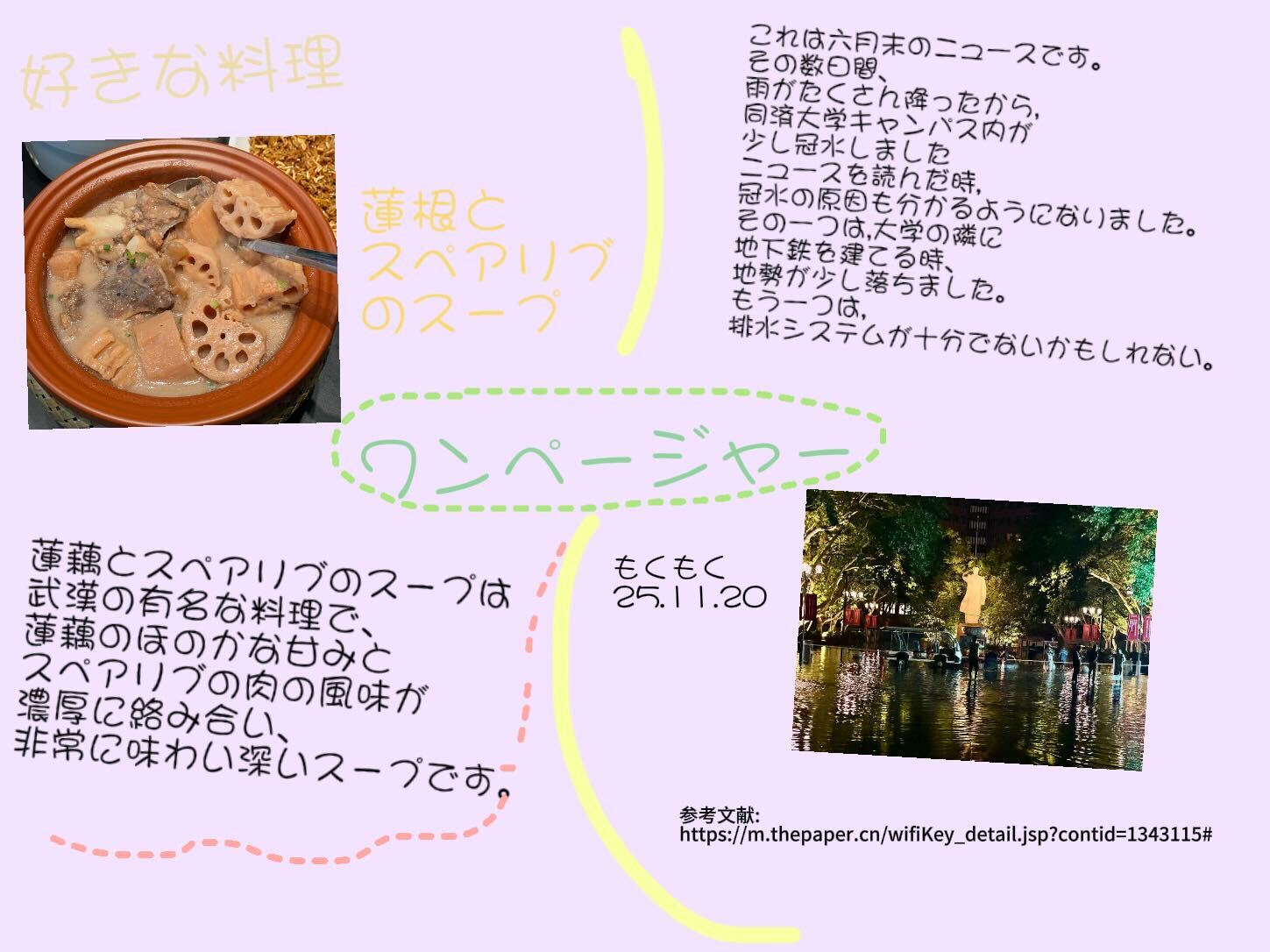
- 自己紹介ビデオ(YouTube)へリンク
- すみちゃん
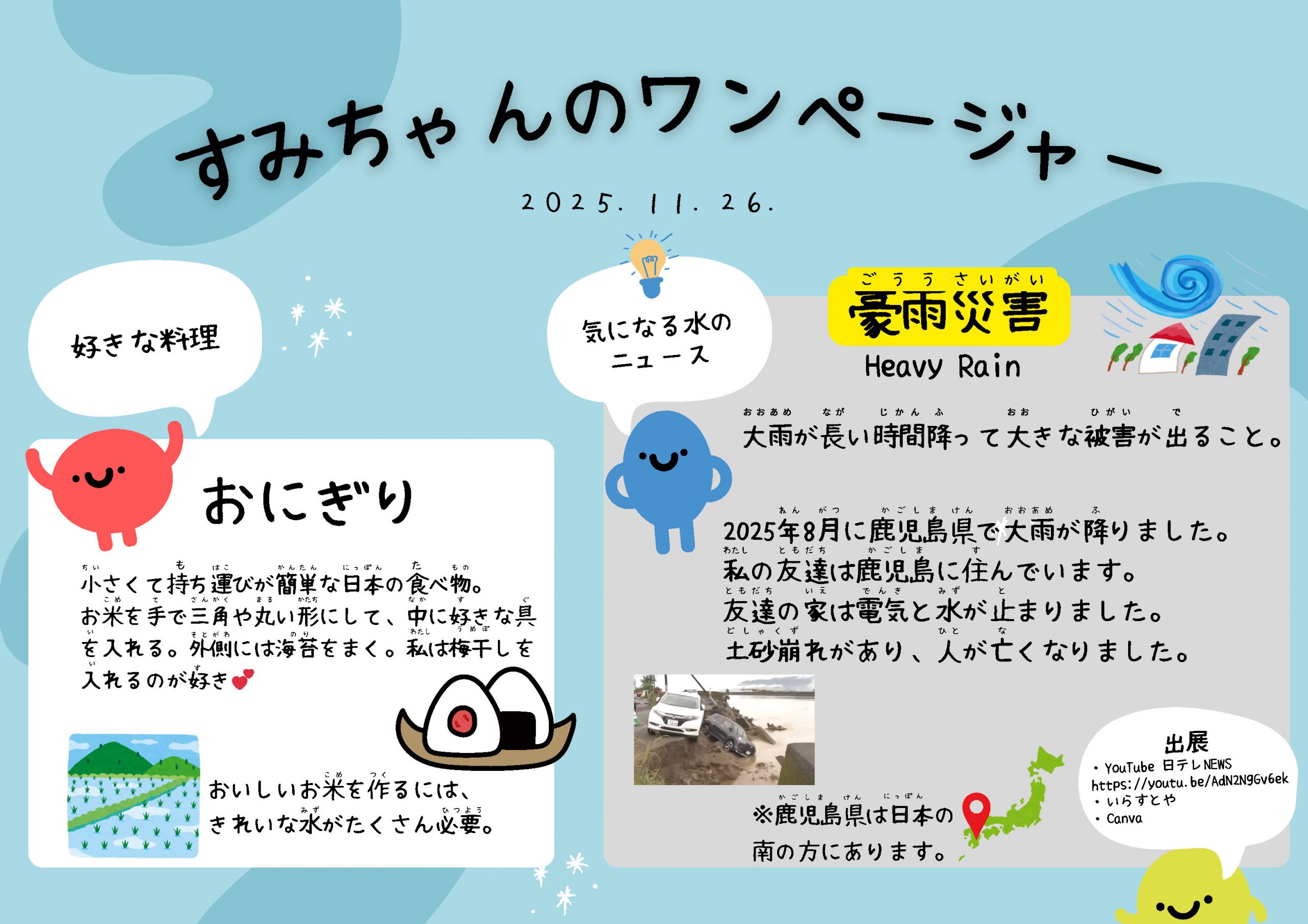
- りくさん
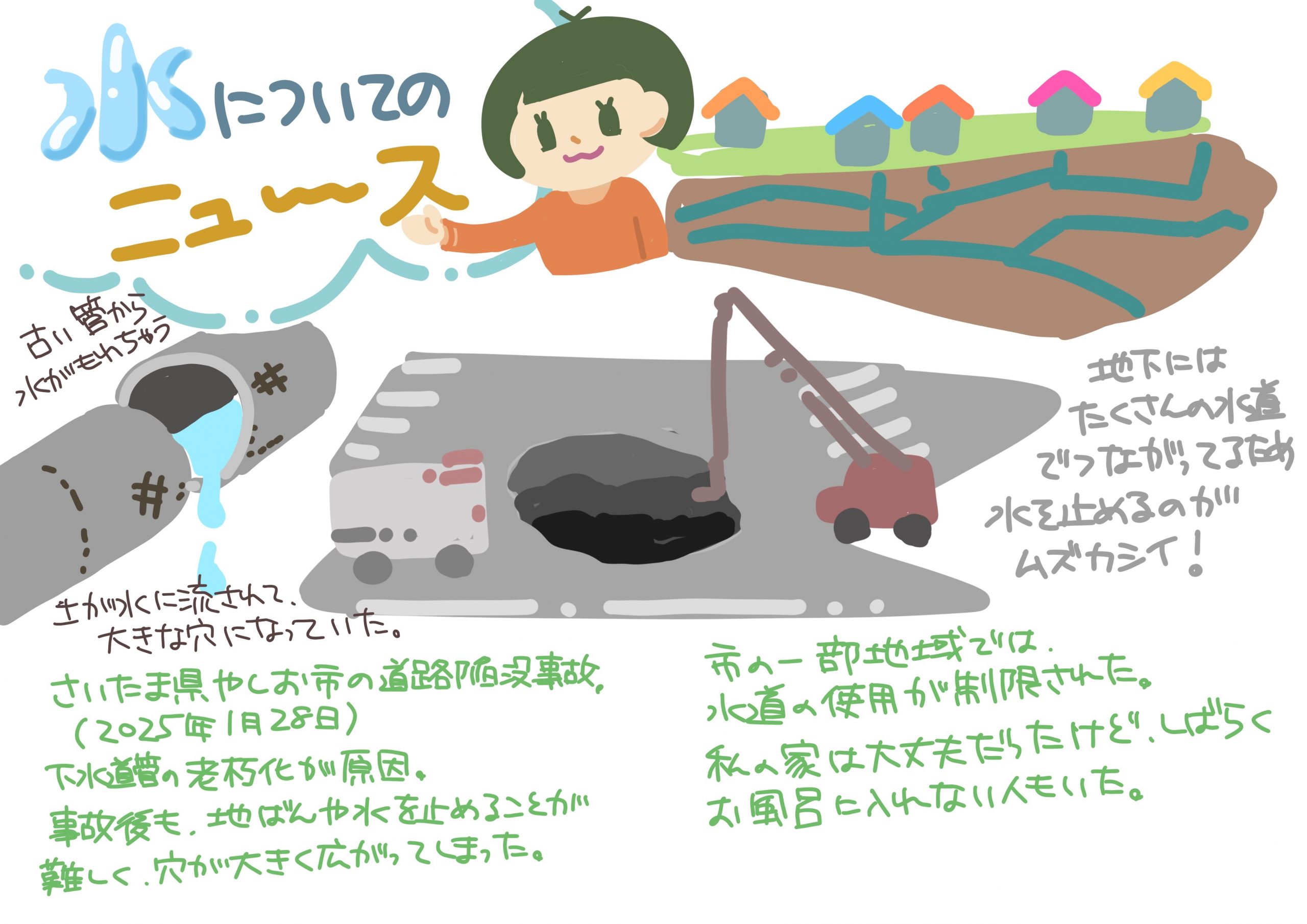
- りくさんのワンページャーは指定どおりでないため、改めてアップします。
講師、事務局
- のんきさん
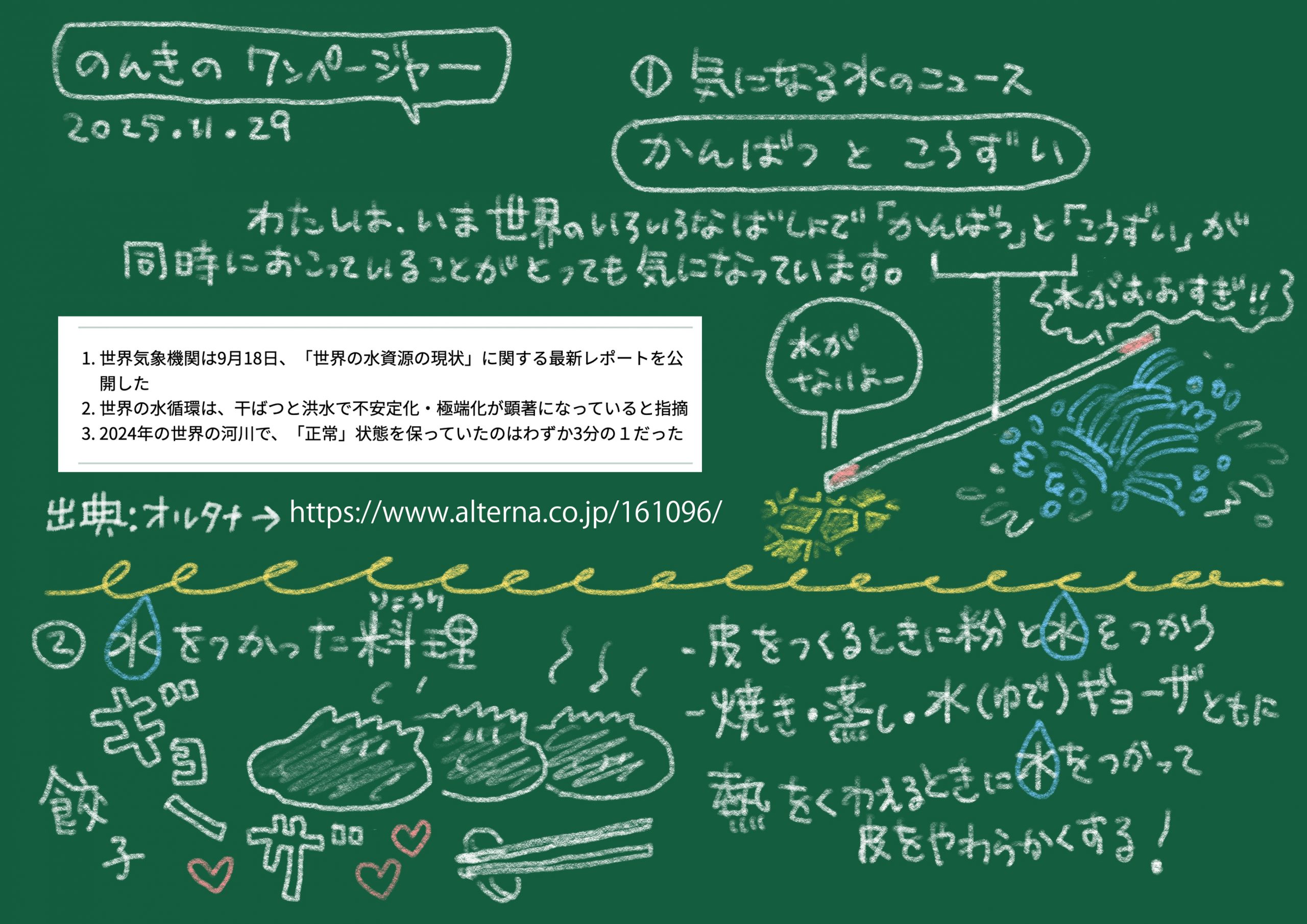
- <ワンページャーの出典>
- <ビデオのテロップ>
- おはようございます、のんきです
- おきたらお湯をのみます(200ml)
- 植木(うえき)にお水をあげます(2L)
- おふろにはいります(200L)
- コーヒーをのみます(200ml)
- 洗いもの(あらいもの)をします(10L)
- かおを洗います(10L)
- 洗たく(せんたく)にはお風呂(ふろ)の水を使って すすぎはあたらしい水でします(4oL)
- 合計262L+400mlでした。 朝だけでもけっこうつかうね、お水。
- <ビデオのテロップ>
- さとーさん
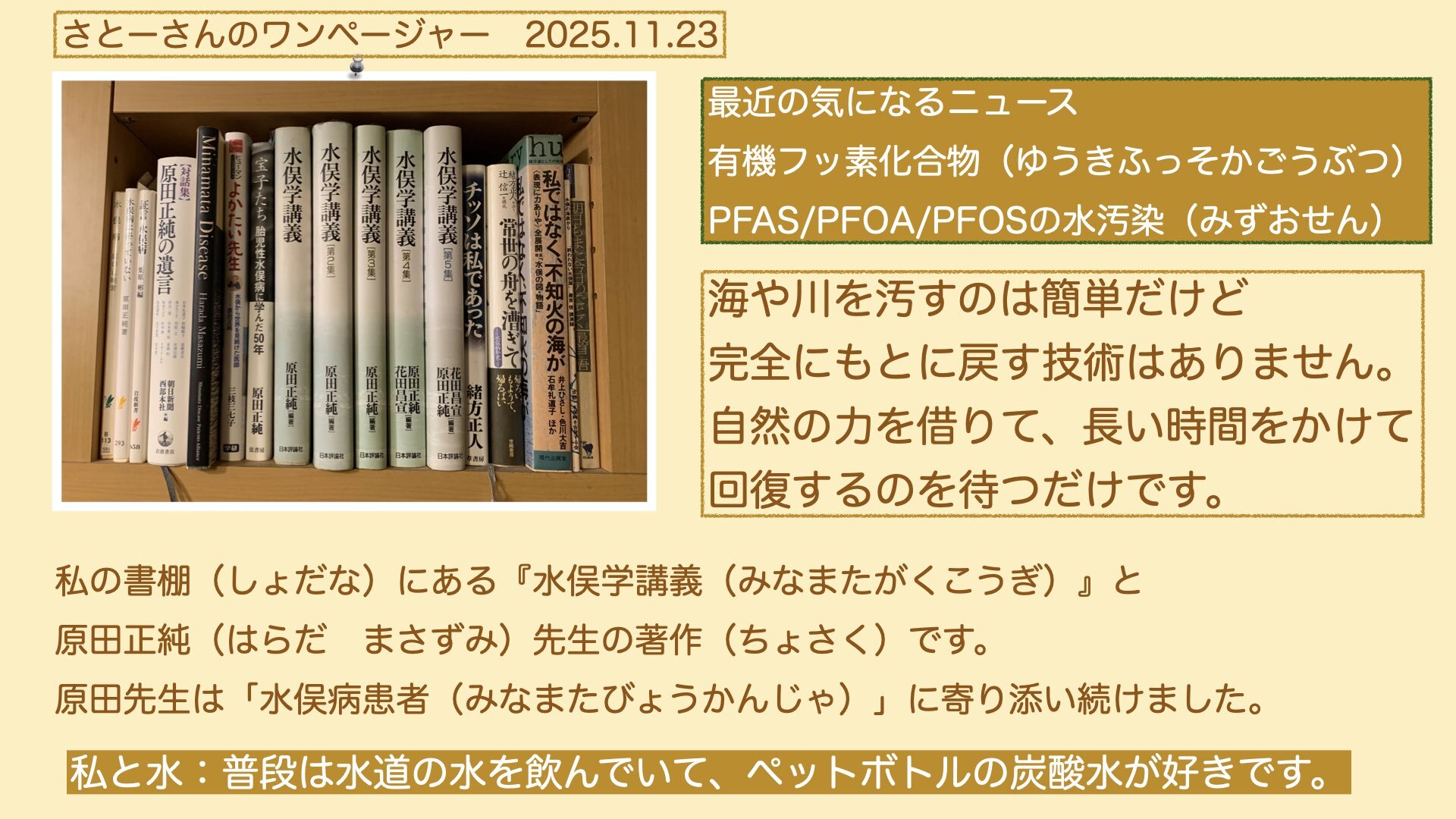
- 「水の問題」といえば、僕は長年「水俣(みなまた)」のことを考えて来ました。
- 母の実家が水俣にあり、叔父は「チッソ水俣工場(ちっそ みなまたこうじょう)」に勤めていました。
- 「チッソ水俣工場」は有機水銀(ゆうきすいぎん)を含んだ工場排水を海に流し続け、海や魚介類を汚し続けました。熊本県水俣市(くまもとけん みなまたし)は、「日本の四大公害(よんだいこうがい)」「水俣病の町」として、有名になってしまいます。
- 「水俣病(みなまたびょう)」が公式発見されたのは1956年です。被害者は貧しい漁民やその家族、生まれてきた子どもたちでした。その子どもたちは今、70歳前後です。
- 水俣病の裁判は、チッソ、熊本県、国を相手に被害者とその支援者が対立しました。
- 今でも続いている訴訟があります。
- 熊本大学(くまもとだいがく)の医師だった原田正純(はらだ まさずみ)先生は、胎児性水俣病(たいじせいみなまたびょう)患者を発見し支え続け、世界に「水俣病(みなまたびょう)」を知らせました。
- 漁業者は身体の障害に加え、仕事を奪われ、収入が途絶え、重い障害を持って生まれた子どもたちを育てました。ひどい差別(さべつ)もありました。
- 原田先生は「公害病で差別が生まれると思っていたけれど、そうではなくて、差別のある場所に公害がやってきた」と語っています。
- 社会的な格差のある場所、貧しい地域に公害が押し付けられてきた、ということです。
- 水俣で起こったことを学び続けるために「水俣学(みなまたがく)」が語られました。
- 一度、汚されてしまった海は、元には戻りません。多くの生き物や人が死に、傷つきました。
- 埋め立てられた海には、今も危険な猛毒があり続けているのです。
- Speaking of water issues, I’ve been thinking about Minamata for many years.
- My mother’s family home was in Minamata, and my uncle worked at the Chisso Minamata Factory.
- The Chisso Minamata Factory continued to discharge industrial wastewater containing organic mercury into the sea, polluting the sea and seafood. Minamata City in Kumamoto Prefecture in the Southwest Island Kyushu, became known as one of the “four major pollution areas in Japan” and the “Minamata disease town.”
- “Minamata disease” was officially discovered in 1956. The victims were poor fishermen, their families, and the children they had. Those children are now around 70 years old.
- The Minamata disease lawsuits pitted victims and their supporters against Chisso, Kumamoto Prefecture, and the national government.
- Dr. Masazumi Harada, a doctor at Kumamoto University, discovered and supported patients with fetal Minamata disease, bringing Minamata disease to the world’s attention.
- In addition to suffering physical disabilities, the fishermen lost their jobs, their incomes were cut off, and they had to raise children born with severe disabilities. They also faced severe discrimination.
- Professor Harada said, “I thought that pollution-related diseases would give rise to discrimination, but that is not the case; rather, pollution arrived in places where discrimination already existed.”
- In other words, pollution was forced upon places with social inequality, poor areas.
- “Minamata Studies” was born as a way to continue learning about what happened in Minamata.
- Once the sea is polluted, it cannot be restored to its original state. Many creatures and people were killed and injured.
- Dangerous toxins continue to linger in the reclaimed sea to this day.
- <さとーさんの11月30日プレゼン概要の中国語訳―大学生リーダー もくもくさん>
- 刚刚さとーさん说的,大致是以下内容。
- 水俣是日本熊本县的一个地方,以前每次回母亲的家乡都会去水俣,大学时也去过那里。
- 我研究过水俣,也看过很多相关的电影,但似乎这个问题至今仍未得到解决。
- 水俣病于1956年被公众正式确认,但至今已过去70年,问题依然没有得到解决。
- 海洋看起来或许干净了一些,但实际上,大量的毒物被倾倒在了海底,现在许多受污染的鱼类和其他生物都被埋在了地下,人们担心它们会再次出现。
- 我一直对这个问题很感兴趣,并且一直在研究它。
- 原田正純是一位医生,长期照顾患有水俣病的儿童,他已经去世了,但我仍然在读他的书。
- 他告诉我,一旦海洋被污染,无论经过多少年,都永远无法完全恢复。这是一个非常重要的教训。
- はせさん
- えりさん
- 自己紹介ビデオ(YouTube)へリンク
- <ワンページャーの出典>
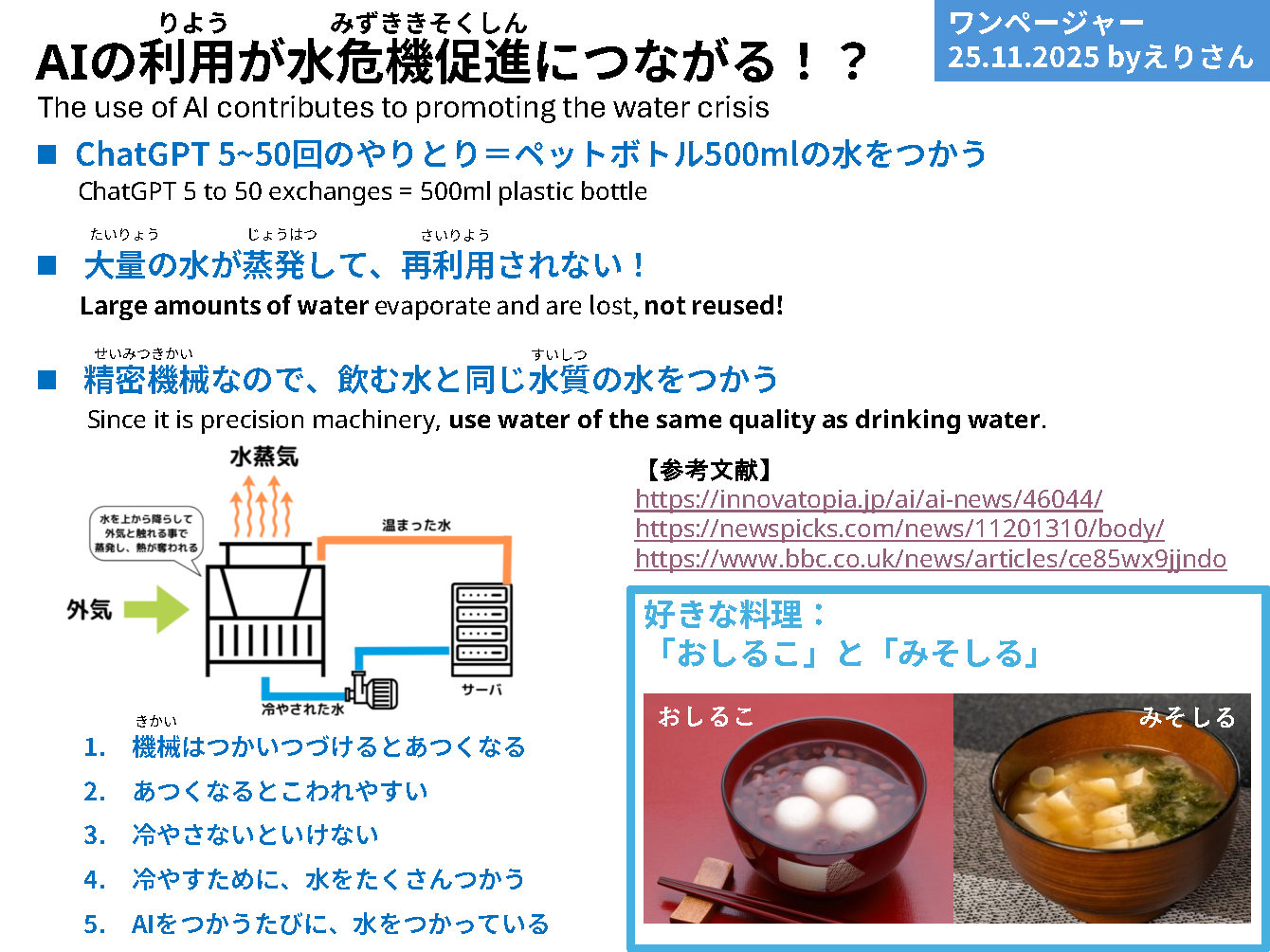
- innoVatopia 20250107 データセンターの水消費危機:ChatGPT利用10回でペットボトル1本分、Microsoft・Googleが新冷却技術で対策へ
- https://innovatopia.jp/ai/ai-news/46044/
- Newspicks 20250129 AIを支えるデータセンターを冷やすための必須装置
- https://newspicks.com/news/11201310/body/
- BBC 20250207 Concern UK’s AI ambitions could lead to water shortages
- https://www.bbc.com/news/articles/ce85wx9jjndo
- <ワンページャーの出典>
- なみさん
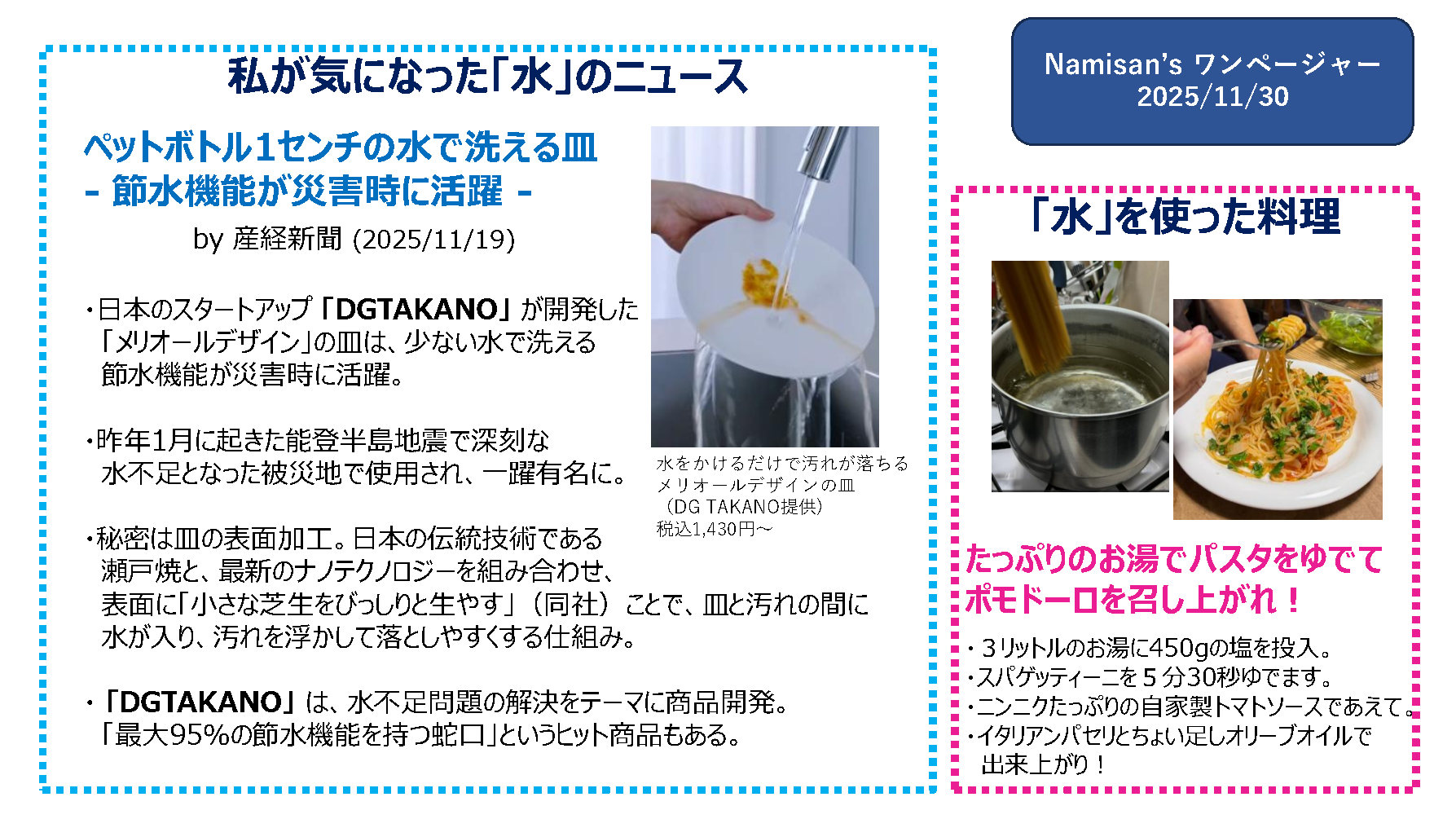
- <なみさんが気になった「水」のニュース やさしい日本語>
- すくない 水で 洗える(あらえる) 皿(さら)
- 日本の「DG TAKANO(ディージータカノ)」が開発(かいはつ)した 新しい(あたらしい)皿(さら)の ニュース。
- <なみさんが気になった「水」のニュース やさしい日本語>
- ●すくない 水で 洗える(あらえる)
- この皿(さら)は、ペットボトルに 1センチくらいの 水が あれば、きれいに洗える(あらえる)。
- ●地震(じしん)の ときに べんりだ
- 2024年 1月に、日本で 大きな 地震(じしん)が あった。水がなくて こまった。この さらは 水を あまり 使(つか)わず、とても 役に立った(やくにたった)。
- ●どうして きれいになるのか?
- さらの表面(ひょうめん)に 特別な加工(とくべつな かこう)が してあるので、水をかけるだけで、汚れ(よごれ)が落ちる(おちる)。
- 日本の焼き物(やきもの)である「瀬戸焼(せとやき)」と、新しい技術(ぎじゅつ)「ナノテクノロジー(nanotechnology)」をつかう。
- さらの表面(ひょうめん)には、とても小さな芝生(しばふ)のようなものがたくさんついている。さらと汚れ(よごれ)のあいだに 水がはいるので、汚れが浮いて取れる(ういて とれる)。
- ●「DG TAKANO(ディージータカノ)」について
- この 会社(かいしゃ)は、「水」の 問題(もんだい)を 考えている。水を 95%も 節約(せつやく)できる 水道(すいどう)も つくっている。
- ●すくない 水で 洗える(あらえる)
- 出典 産経新聞2025年11月19日>>https://www.sankei.com/article/20251119-YJYV3KTI4JO4JAGS6HLSZC4AJM/
- 自己紹介ビデオ(YouTube)へリンク
- ひとさん
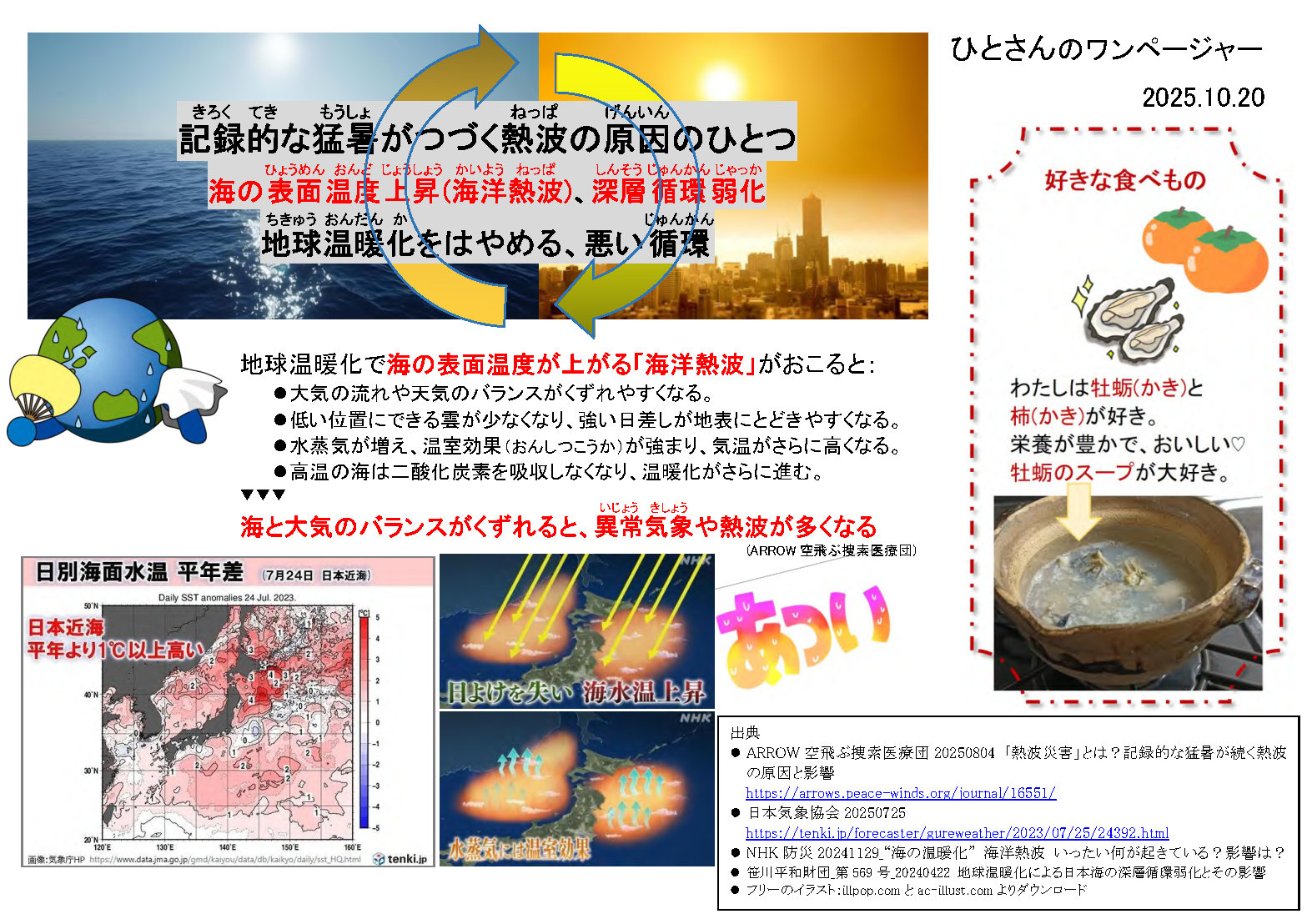
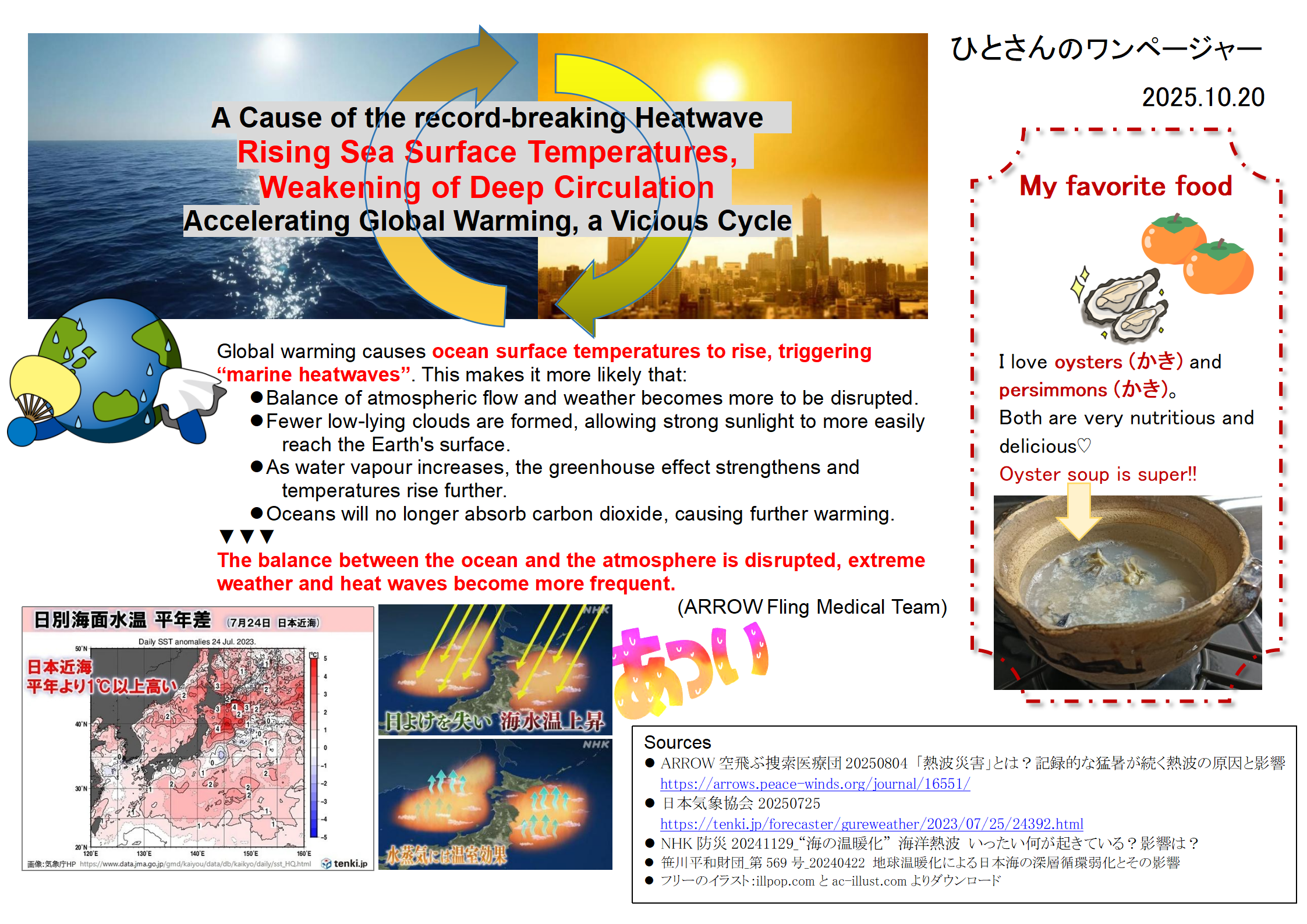
- <ワンページャーの出典>
- ARROW空飛ぶ捜索医療団20250804 「熱波災害」とは?記録的な猛暑が続く熱波の原因と影響
- 日本気象協会20250725 3か月 猛暑は長丁場か 9・10月残暑厳しい 降水量多い所も 台風の動向にも注意
- NHK防災20241129_“海の温暖化” 海洋熱波 いったい何が起きている?影響は?
- 笹川平和財団_第569号_20240422 地球温暖化による日本海の深層循環弱化とその影響
- フリーのイラスト:illpop.comとac-illust.comよりダウンロード
- <ワンページャーの出典>
- <ビデオのテロップ>
- 市の給水所が団地の約1200戸に給水しています
- (声)わたしは水道(すいどう)の水をのんでいます
- 埼玉県新座市(さいたまけん にいざし)の水道の水は70%を川から-
- 30%は市内の地下水(ちかすい)からとっています
- 川の水は埼玉県の北西部(ほくせいぶ)に水源がある「荒川(あらかわ)」からとっています
- わたしは水道水をポットにくみおきします
- 木炭(もくたん)を入れて水道水のにおいを取っています
- 団地のとなりに柳瀬川(やなせがわ)が流れています
- 荒川(あらかわ)に合流して 下流にくらすひとたちの飲み水になります
- <ビデオのテロップ>
- © 2025 一般社団法人アニメーテッドラーニングらぼ/Animated Learning Lab in Japan-ALLjp. All Rights Reserved.